
How We Built AI-Powered Solutions That Transformed Print Industry Workflows
From automated image enhancement to intelligent order processing, here's how InfAI engineered custom AI tools that cut production time, improved quality, and redefined what's possible in print.

Key Takeaways
- 1InfAI built custom AI solutions for print industry clients — including automated image enhancement, background removal, and intelligent order workflows — that reduced order processing time by 60% and dramatically improved output quality.
- 2Our AI-first approach means every service we deliver is engineered with intelligent automation at its core, not bolted on as an afterthought.
- 3From pre-flight quality checks to production-grade image processing at scale, these tools demonstrate how purpose-built AI transforms traditional industries from the inside out.
The print industry isn't the first sector people think of when they hear "artificial intelligence." Most conversations about AI centre on chatbots, autonomous vehicles, or generative content. But for the companies that actually produce millions of printed products every year — photo books, wall art, packaging, marketing collateral — the operational challenges are enormous, repetitive, and ripe for intelligent automation.
That's exactly where we focused. Over the past several years, our team at InfAI has designed, built, and deployed a suite of custom AI-powered tools specifically for print industry workflows. These aren't off-the-shelf solutions repackaged with a new label. They're purpose-built systems engineered to solve real production bottlenecks that our clients face every day.
This post walks through what we built, why it matters, and what the results look like in practice.
The Problem: Print Production at Scale Is a Quality Bottleneck
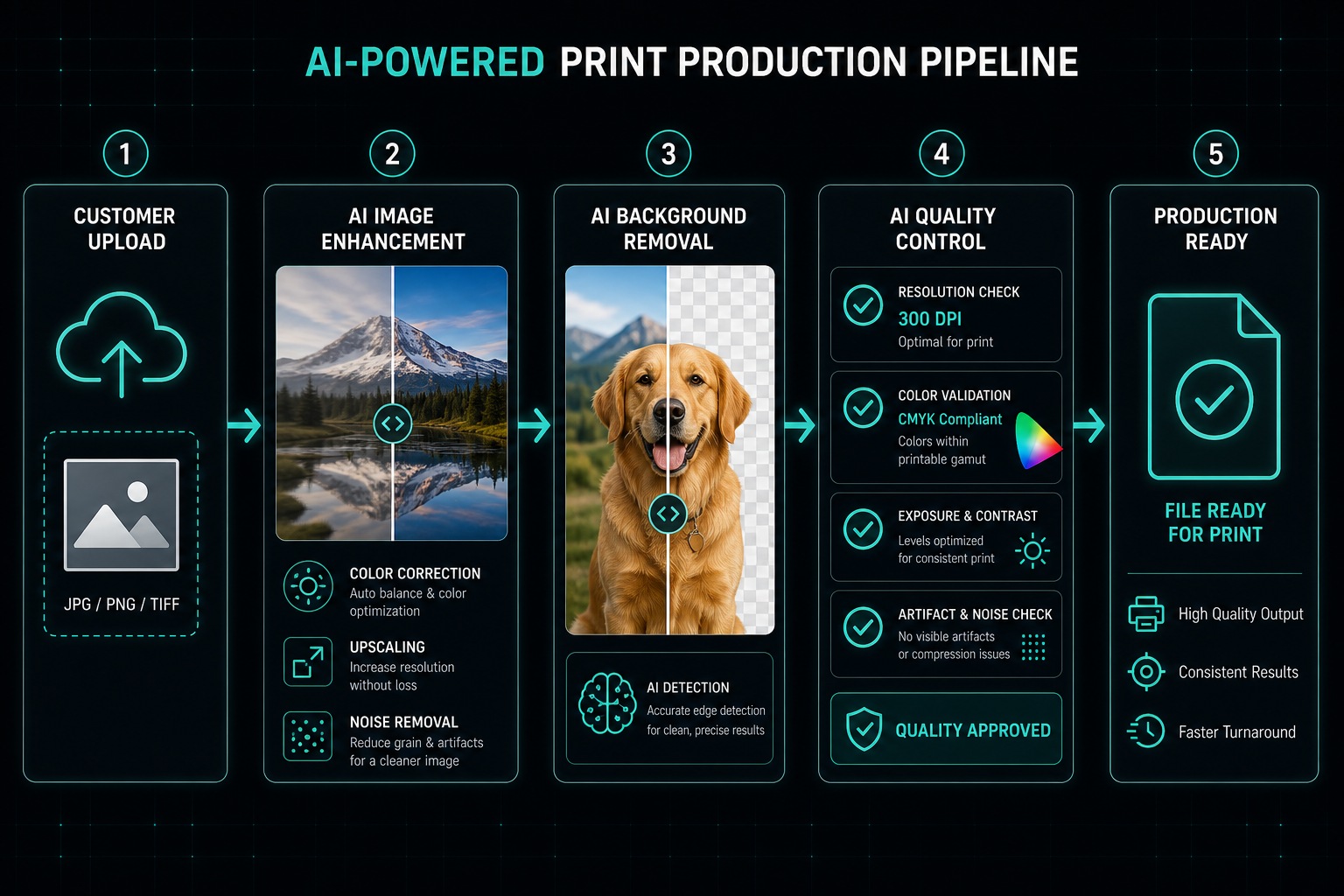
Print production workflows involve a staggering number of manual touchpoints. A single customer order for a photo product might require image colour correction, resolution assessment, background removal, layout adjustments, pre-flight quality checks, and order routing — all before anything hits a press.
When you're handling thousands of orders per day, every manual step becomes a bottleneck. Quality becomes inconsistent. Turnaround times stretch. Skilled operators spend their hours on repetitive tasks instead of the creative and technical work that actually requires human judgement.
Our clients came to us with a clear challenge: make this faster and better without sacrificing quality. We answered with AI.
AI-Powered Digital Image Enhancement
Image quality is the foundation of every print product. A photo book with washed-out colours or a canvas print with visible compression artefacts isn't just a bad product — it's a returned product. Traditional workflows relied on manual colour correction and enhancement by trained operators, which was effective but slow and inconsistent across large volumes.
We built an AI-powered image enhancement pipeline that handles three critical functions automatically:
- Auto colour correction — our models analyse each image's colour profile, white balance, and exposure, then apply intelligent corrections that preserve the photographer's intent while optimising for print output.
- Resolution upscaling — using custom-trained super-resolution models, we upscale low-resolution customer uploads to print-ready quality without introducing artefacts or unnatural sharpening.
- Quality improvement — the system detects and corrects common issues like noise, blur, and compression damage, producing cleaner source files for production.
The key word here is "automatic." These processes run the moment a customer uploads an image, with no human intervention required for the vast majority of files. Our operators now focus on edge cases and creative decisions, not pixel-level corrections on thousands of images.
Automated Background Removal at Production Scale
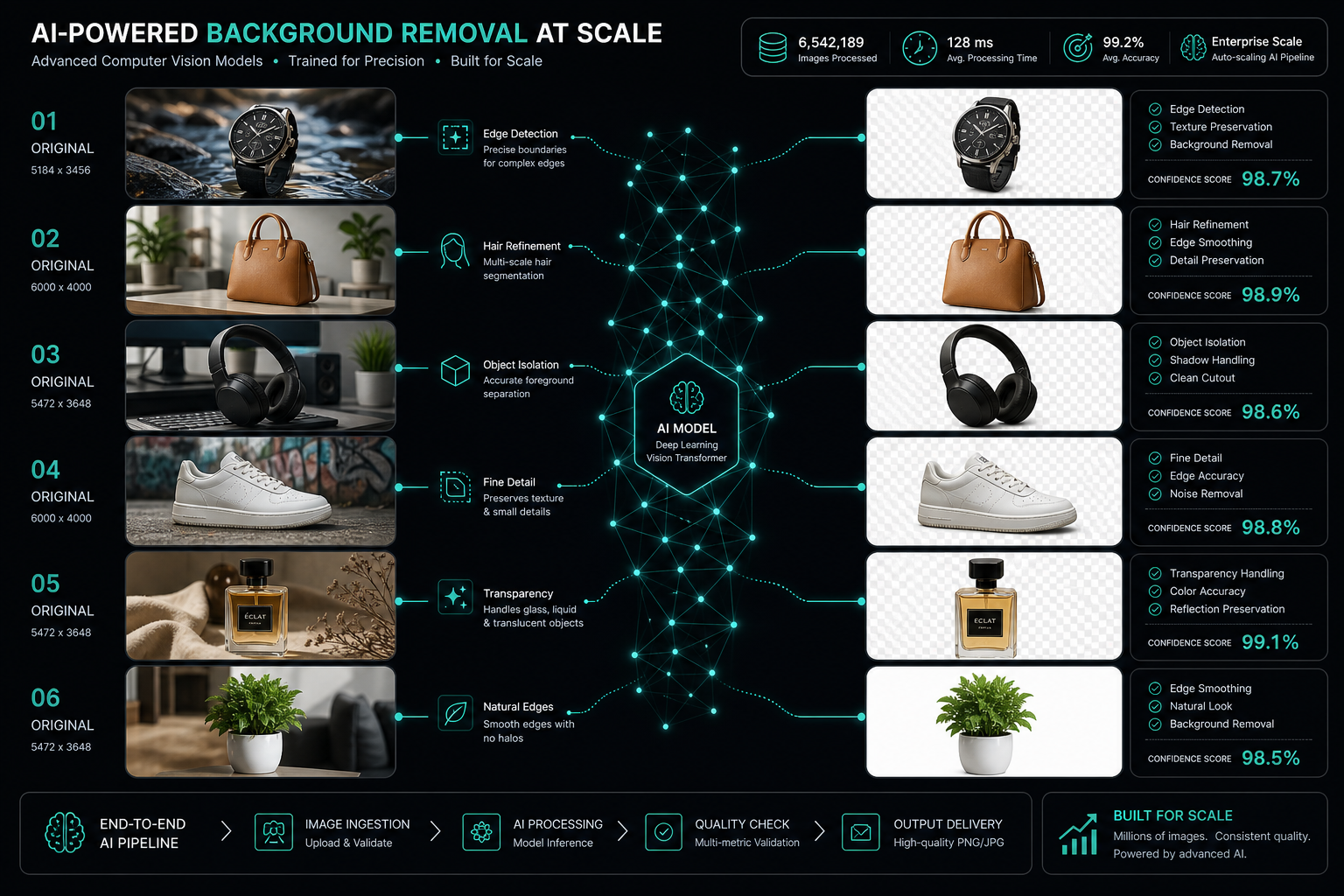
Background removal is one of those tasks that sounds simple until you try to do it at scale. Consumer-grade tools work well enough for social media posts, but print production demands pixel-perfect precision. Hair strands, transparent objects, complex edges, mixed backgrounds — these are the cases where most automated tools fall apart.
We engineered a production-grade background removal system that handles these edge cases reliably. Our approach combines multiple AI models working in concert: a primary segmentation model identifies the subject, a refinement model handles fine detail like hair and fur, and a quality assessment model flags results that need human review.
- Processes thousands of images per hour with consistent, print-ready quality.
- Handles complex edge cases — hair, semi-transparent objects, intricate patterns — that trip up generic tools.
- Confidence scoring routes low-certainty results to human operators, so nothing substandard reaches production.
- Integrated directly into the production pipeline with no manual file handling or separate tool switching.
The result is a system that replaced what was previously a significant manual bottleneck with an automated process that's both faster and more consistent. Our clients' operators went from spending hours on cutouts to reviewing only the small percentage of images that genuinely need a human eye.
Intelligent Order Workflow System
Image processing is only one piece of the puzzle. The order workflow itself — from the moment a customer submits an order to the moment files are production-ready — involved layers of manual routing, status updates, and quality gates that slowed everything down.
We built a custom AI-powered order workflow system that automates the entire chain:
- Automatic order classification and routing based on product type, complexity, and priority.
- Intelligent batching that groups similar jobs for production efficiency.
- Automated status tracking that eliminates manual data entry and keeps clients informed in real time.
- Predictive flagging that identifies potential issues before they become production problems.
- Smart assignment of edge-case work to the operators best suited to handle it.
The impact was immediate and measurable. Order processing time dropped by 60%. Errors caused by manual routing and data entry were virtually eliminated. And because the system learns from every order it processes, it continues to improve over time.
“We don't build AI tools because the technology is trendy. We build them because our clients have real production problems that manual processes can't solve at scale. Every system we deploy has to earn its place by delivering measurable improvements in speed, quality, or both.
AI-Powered Pre-Flight Quality Control
In print production, catching a problem before it reaches the press saves time, materials, and client relationships. Pre-flight checks — the final quality gate before production — were traditionally manual, time-consuming, and subject to human fatigue, especially during high-volume periods.
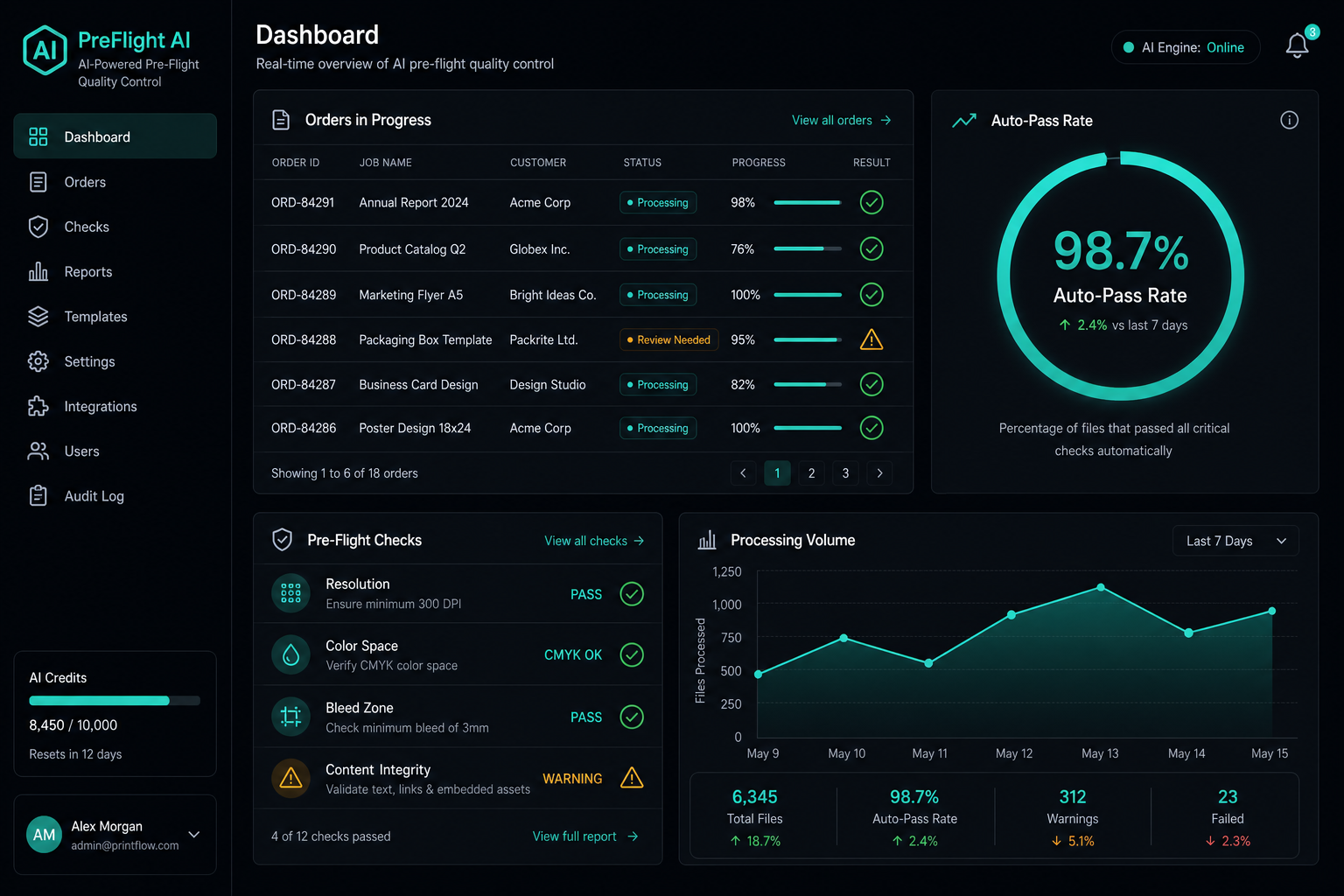
Our AI-powered pre-flight system automates these checks across every order:
- Resolution verification — ensures every image meets minimum DPI requirements for its intended print size.
- Colour space validation — confirms files are in the correct colour profile (CMYK vs. RGB) and flags potential colour shift issues.
- Bleed and safe zone analysis — checks that critical content isn't positioned where it could be trimmed or obscured.
- Content integrity checks — detects corrupted files, missing assets, and format inconsistencies before they cause production failures.
What used to take a skilled operator several minutes per order now happens in seconds. More importantly, the AI doesn't get fatigued at 4 PM on a Friday. Every single order gets the same thorough inspection regardless of volume or time of day.
Pro tip: If you're evaluating AI solutions for your production workflow, start with your highest-volume, most repetitive quality gates. These are where automation delivers the fastest ROI and where human fatigue causes the most inconsistency.
Why "AI First" Isn't Just a Tagline for Us
There's a meaningful difference between a company that adds AI features to existing services and one that builds every solution with AI at the foundation. At InfAI, our approach is the latter.
When a client comes to us with an operational challenge, our first question isn't "how many people do we need to throw at this?" It's "what can we build that makes the work fundamentally faster and better?" Sometimes the answer is a fully automated pipeline. Sometimes it's an AI-assisted tool that makes human operators dramatically more productive. But AI is always part of the conversation from the start.
This matters because the alternative — layering automation onto a process that was designed for manual execution — rarely delivers the results clients expect. When you design for AI from the ground up, you get:
- Workflows that are structured for machine processing, with human intervention only where it genuinely adds value.
- Data pipelines that feed continuous model improvement, so the system gets smarter with every order it handles.
- Integration points that are clean and efficient rather than bolted on after the fact.
- Measurable outcomes that compound over time as models train on more production data.
Every service InfAI delivers — from creative production to operations support — is engineered with this mindset. AI isn't a feature we sell. It's how we build.
What This Means for Print Industry Clients
The print industry is under pressure from every direction: customer expectations for faster turnaround, tighter margins, increasing personalisation demands, and the need to maintain quality at higher volumes. These pressures aren't going away — they're intensifying.
The solutions we've built aren't theoretical. They're running in production, processing real orders, and delivering results that our clients measure in hours saved, errors prevented, and revenue protected. And because we designed them as flexible, evolving systems, they adapt as client needs change.
- Production teams can handle significantly higher volumes without proportional headcount increases.
- Quality becomes consistent and measurable rather than dependent on individual operator skill.
- Turnaround times shrink, giving clients a competitive advantage in markets where speed matters.
- Operators are freed from repetitive work and can focus on the creative and technical decisions that drive real value.
If your print production workflow still relies on manual processes for image enhancement, quality control, or order routing, there's a better way. We've built it, we've proven it, and we're ready to show you what it can do.
FAQs
Any print operation handling high volumes of customer-submitted images — photo product companies, wall art producers, packaging firms, and marketing print houses — will see significant benefits. The ROI is strongest when you're processing thousands of orders daily and manual bottlenecks are limiting your throughput or quality consistency.
It depends on the complexity of your current systems, but most implementations follow a phased approach. An initial pilot — typically focused on image enhancement or pre-flight checks — can be operational within 6-8 weeks. Full workflow integration, including order routing and quality control automation, usually takes 3-4 months from kick-off to production deployment.
No, and that's by design. Our systems automate the repetitive, high-volume work that doesn't require human judgement — colour correction on thousands of standard images, routine pre-flight checks, order routing. Human operators still handle creative decisions, edge cases, and quality oversight. The goal is to make your team dramatically more productive, not to eliminate them.
Every system we build includes confidence scoring and automatic fallback routing. When the AI is uncertain about a result — whether it's a complex background removal or an unusual colour profile — it flags the file and routes it to a human operator for review. Nothing reaches production without passing quality thresholds, whether those checks are automated or manual.
Yes. We design every solution with integration as a core requirement, not an afterthought. Our systems connect via APIs and can work alongside existing production management platforms, RIP software, and print hardware workflows. We assess your current technology stack during the scoping phase and build integration points that fit your environment.
Build Your Team, Not Just a Contract
With InfAI's offshore dedicated teams, you get professionals who join your workflow for the long run. Grow steadily, stay flexible, and work with people who care about your success as much as you do.