
How to Build an Offshore AI and Data Team in India: A Step-by-Step Guide
Most companies stall on AI because they cannot hire the people to build it. Here is the practical playbook for building a dedicated AI and data team in India, from the first use case to a model in production in 90 days.
Key Takeaways
- 1The hardest part of AI adoption is not the model. It is finding and keeping the engineers who can turn your data into something that runs in production, and that talent is scarce and expensive in the US and UK.
- 2India has one of the largest AI and data talent pools in the world, which is why so many global companies now run their AI work from Indian capability centres. A dedicated offshore team gives you that talent without the overhead of setting up your own entity.
- 3The playbook is six steps: define one or two use cases, fix your data, shape the team for your stage, pick a dedicated model over freelancers, hire on real tasks, and aim for a model in production within 90 days.
Almost every leadership team we speak to has an AI plan. Far fewer have an AI team.
The plan usually looks good on paper: automate document processing, add forecasting to the supply chain, put a smart assistant in front of customer support. Then it meets the hiring market. Senior machine learning engineers in the US and UK are among the most expensive hires in tech, the good ones get multiple offers, and the search drags on for months while the roadmap waits.
That is why a growing number of companies are building their AI and data teams offshore, and why India is usually at the top of the list.
This guide is the practical version. What to decide before you hire anyone, which roles you actually need at each stage, how to assess candidates properly, and what a realistic first 90 days looks like. It is the same process we run when we build AI teams for clients in Mumbai.
Why build your AI team in India?
India has spent two decades becoming the engineering back office of the world, and over the last few years that has shifted decisively towards higher-value work. Global capability centres in India now run core product engineering, analytics and AI for some of the largest companies in the world, not just support and testing.
For an AI team specifically, three things matter:
- Depth of talent. India produces a very large number of engineering and computer science graduates every year, and a fast-growing share of them specialise in data engineering, machine learning and applied AI. Independent research such as the Stanford AI Index has consistently ranked India among the leading countries for AI skills.
- Production experience. Many Indian engineers have built and run data platforms for global banks, retailers and SaaS companies. You are not only hiring people who can train a model in a notebook, you are hiring people who have shipped pipelines that run every night.
- Cost that makes a team possible. A senior ML engineer in a major US city can easily cost well over $150,000 a year before benefits. In India, comparable talent typically costs a fraction of that, which means you can fund a small, balanced team for roughly the cost of one onshore hire.
None of this matters if you build the team the wrong way. So let us get into the process.
The 6-step process to building an offshore AI team
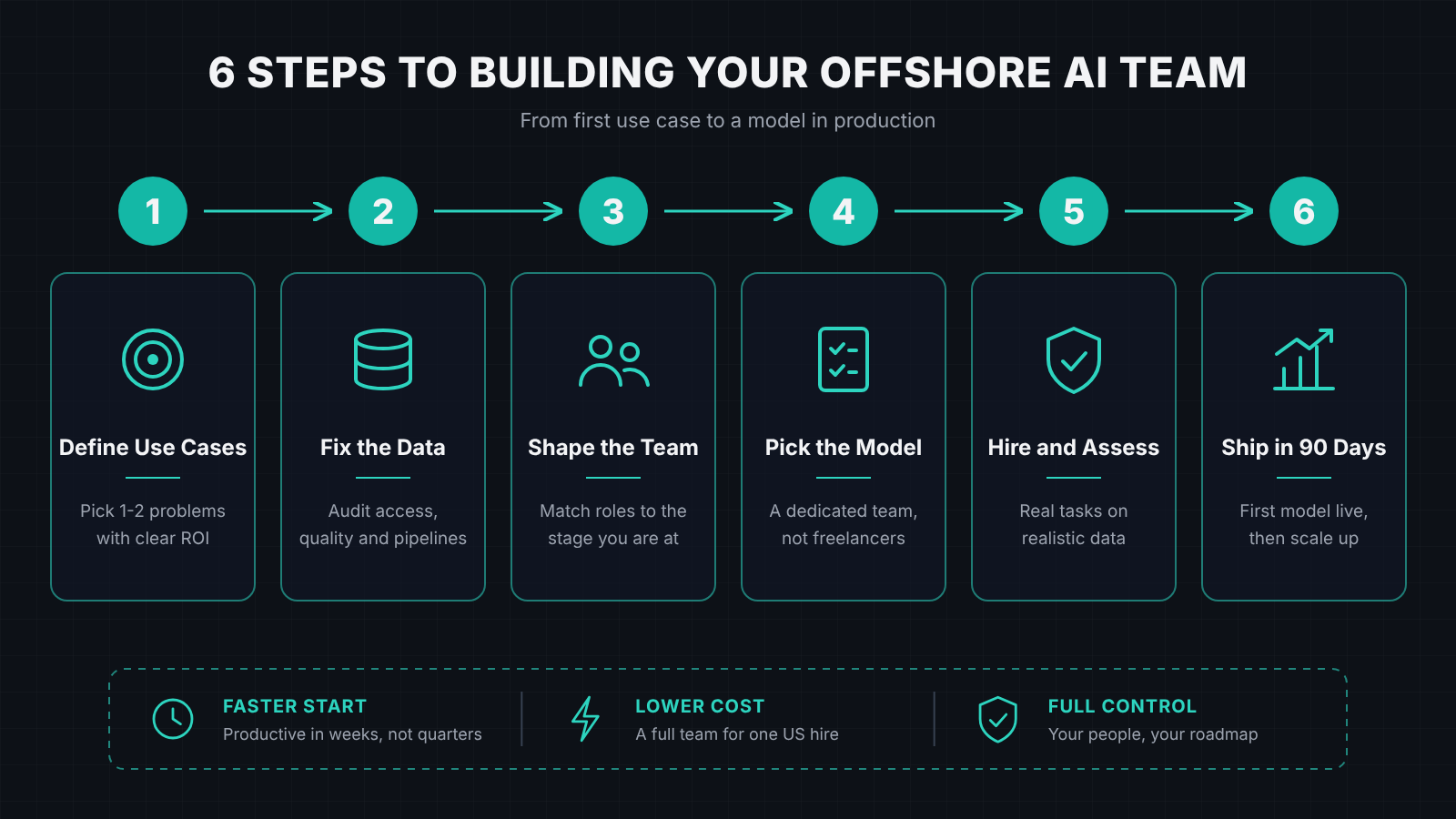
Step 1: Define one or two use cases with clear ROI
The most common reason AI teams fail is not talent. It is a vague brief. "Do something with AI" produces demos, not results.
Before you hire, pick one or two problems where you can name the business metric that will move. Good first use cases tend to share a few traits:
- The data already exists and someone can give the team access to it.
- There is a clear before and after, such as hours of manual review saved, forecast error reduced, or tickets resolved without a human.
- A business owner cares about the outcome and will make time to review results.
- The first version can be useful without being perfect.
Document processing, demand forecasting, lead scoring, support ticket triage and internal knowledge search are reliable starting points. Leave the moonshots for year two.
Step 2: Fix the data before you hire data scientists
A data scientist without clean, accessible data spends their first six months doing data engineering, usually badly and usually frustrated. Run a short audit first. Where does the data for your use case live? Who owns it? How is access granted, and what are the security and privacy rules around it? How much of it is actually usable?
If the answer to most of these is "we are not sure", your first hire should be a data engineer, not a data scientist. That one decision saves more time than any other on this list.
Step 3: Shape the team for the stage you are at
You do not need a ten-person AI department on day one. You need the smallest team that can get one use case into production, and then a plan to grow it as the results justify the investment.
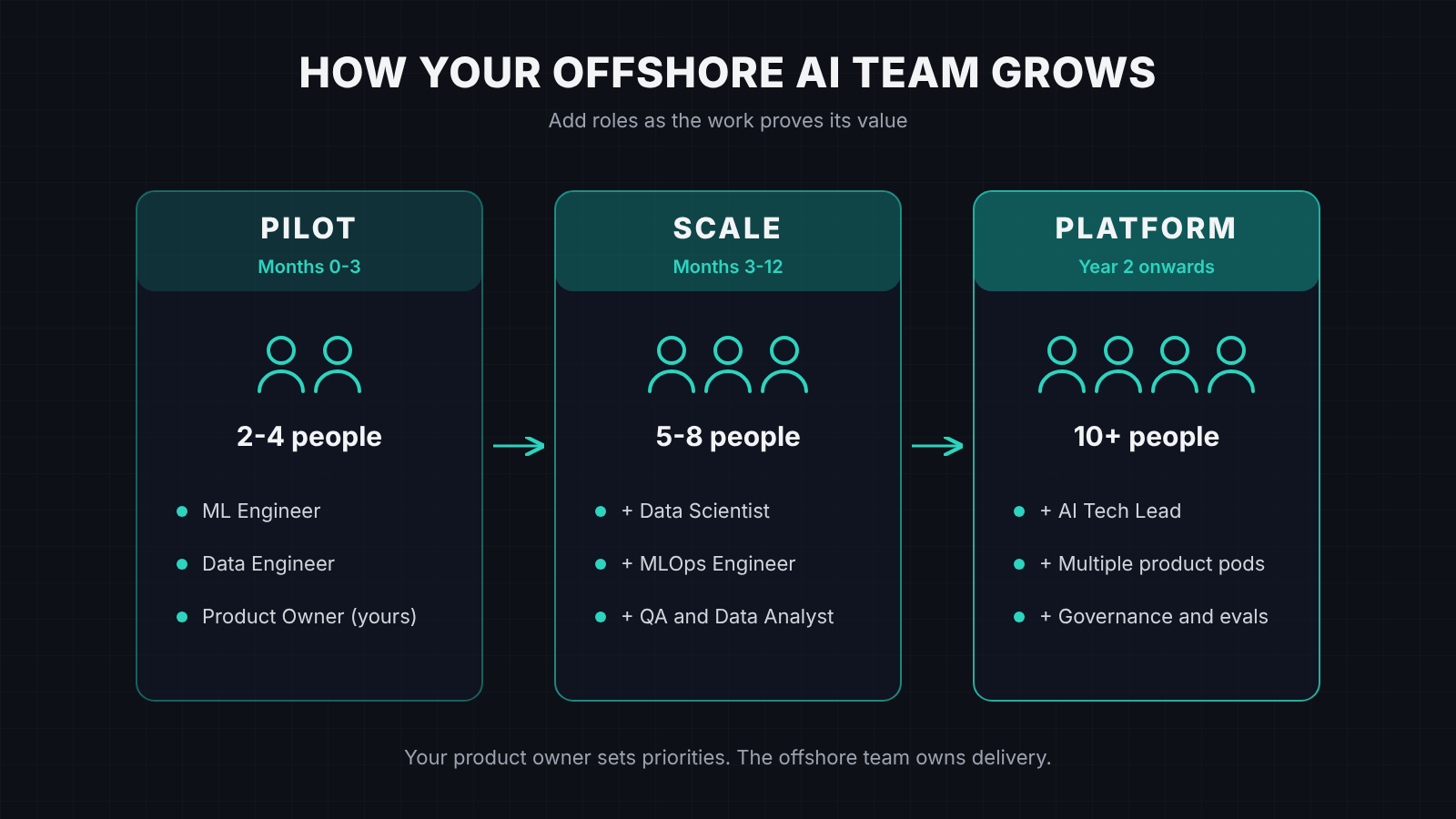
In practice we see three stages:
- Pilot (2-4 people, months 0-3): an ML engineer and a data engineer, with a product owner on your side who sets priorities and signs off results.
- Scale (5-8 people, months 3-12): add a data scientist for experimentation, an MLOps engineer to make deployment and monitoring repeatable, and QA or analyst support.
- Platform (10+ people, year two onwards): an AI tech lead, several small pods each owning a product area, and proper governance and evaluation processes.
Pro tip: Keep the product owner role on your side, even when the rest of the team is offshore. The team in India should own delivery, but someone inside your business has to own the question "is this actually useful?" Teams without that person drift towards interesting work instead of valuable work.
Step 4: Choose a dedicated team, not a pool of freelancers
There are three common ways to access AI talent in India, and they produce very different results:
- Freelancers are fine for a one-off proof of concept, but AI systems need ongoing care. Models drift, data changes and pipelines break. When the freelancer moves on, so does the knowledge.
- Project-based agencies deliver a scoped piece of work and hand it over. You get an output, but you rarely build lasting capability, and you lose visibility into how decisions were made.
- A dedicated offshore team works only for you, uses your tools and repositories, and builds up knowledge of your data over time. This is the model that compounds.
For anything you expect to run for more than a few months, the dedicated model wins. AI work rewards context, and context only builds when the same people stay on the problem.
Step 5: Hire and assess on real work
AI interviews are notoriously easy to game. Candidates can recite the theory behind transformers and still struggle to clean a messy dataset. The best signal comes from work that looks like the job:
- A short take-home task using realistic, anonymised data from your domain, with a written explanation of the choices made.
- A review session where the candidate walks through their solution and responds to questions about trade-offs, not trivia.
- A system design conversation about how they would take the model to production, monitor it and retrain it.
- A communication check. Can they explain a result to a non-technical stakeholder in plain English?
This takes more effort than a standard coding test, but it filters for exactly the skills that decide whether your AI work ships.
“The difference between an AI team that delivers and one that produces slide decks is rarely raw intelligence. It is whether the team has shipped production systems before, and whether someone on the business side is pulling the results into real decisions.
Step 6: Aim for a model in production within 90 days
Ninety days is long enough to do things properly and short enough to keep everyone honest. It also gives leadership a clear checkpoint to decide whether to scale.
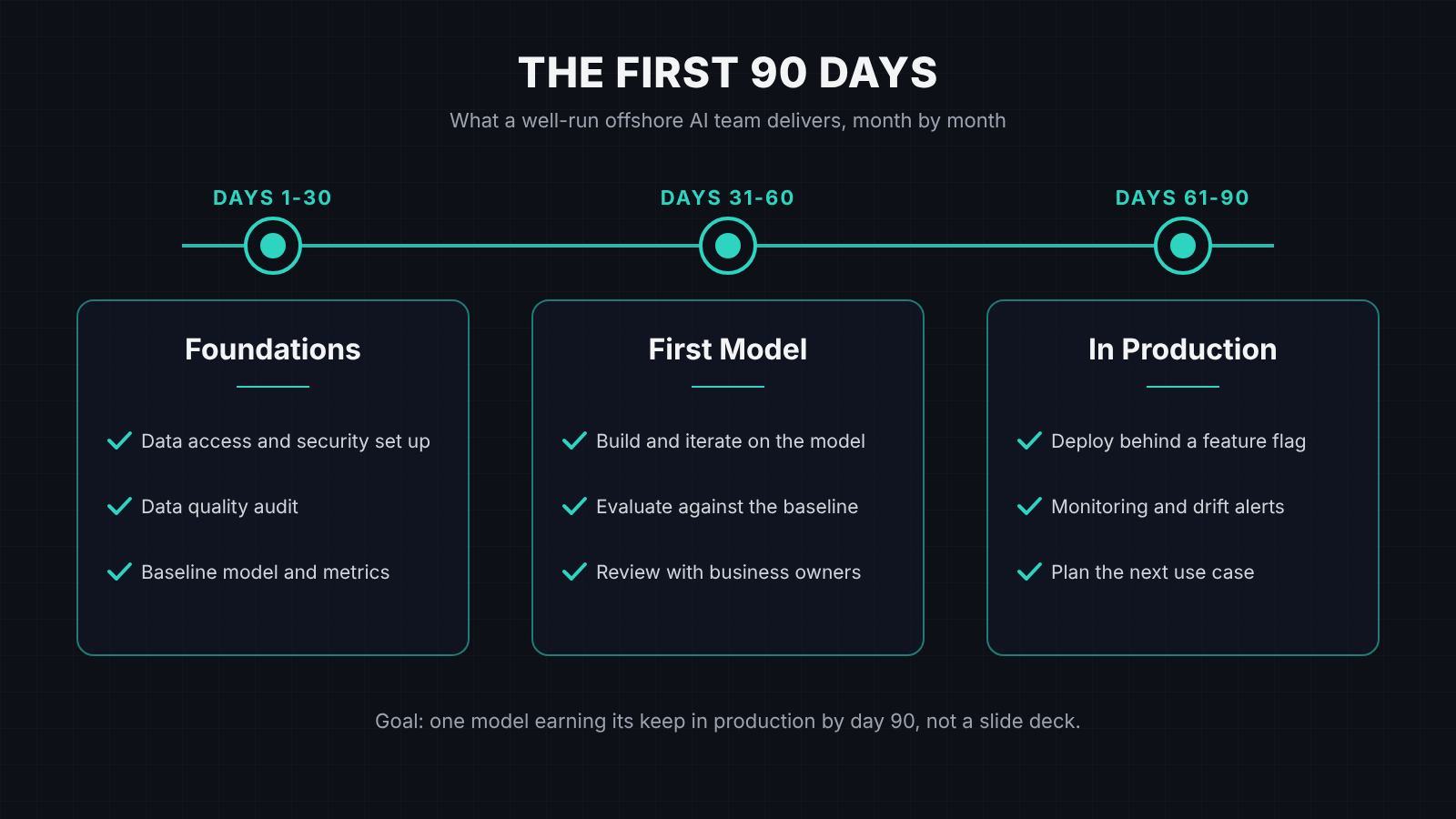
- Days 1-30, foundations: set up secure data access, run the data quality audit, and build a simple baseline so you know what "better" looks like.
- Days 31-60, first model: build and iterate, evaluate against the baseline, and review results with the business owner every week.
- Days 61-90, in production: deploy behind a feature flag, add monitoring and drift alerts, and pick the next use case.
If you reach day 90 with a working model that a business team actually uses, you have earned the right to grow the team.
Common mistakes to avoid
We have seen the same few mistakes derail offshore AI teams again and again:
- Hiring researchers when you need engineers. Most companies need applied ML engineers who can ship, not PhDs pushing the state of the art.
- Skipping security and data governance. Agree access controls, data residency and model usage rules on day one, especially if you handle customer or financial data.
- Treating the offshore team as a ticket queue. AI work needs context. Invite the team into planning, share the business goals, and give them direct access to the people who use their output.
- Measuring activity instead of outcomes. Count models in production and business metrics moved, not experiments run.
How InfAI builds AI teams in Mumbai
At InfAI, we build dedicated AI, data and engineering teams for companies in the US, UK and Europe, based in Mumbai. We handle recruitment, assessment, HR, infrastructure and day-to-day management, and the team works inside your tools, on your roadmap, as an extension of your own engineering function.
We are also an AI-first engineering company ourselves, so we know what good looks like. We help you pick the first use case, shape the right team for your stage, and run the 90-day plan above with you rather than handing it over and hoping for the best.
If you are working out how to staff your AI roadmap, we would be happy to talk it through. We can show you what a pilot team would look like for your use case, what it would cost, and how quickly it could be up and running.
FAQs
It depends on seniority and team size, but most companies find they can fund a small pilot team of two to four people for roughly the cost of one senior AI hire in the US or UK. The bigger saving comes later, when you can scale the team without the same hiring delays.
Data engineers, ML engineers and data analysts are available in depth, particularly in Mumbai, Bangalore, Pune and Hyderabad. Very senior specialists, such as people with deep experience running large-scale MLOps platforms, take longer to find anywhere, so plan more time for those roles.
Yes, if you set it up properly. That means role-based access, secure devices and networks, clear data handling agreements, and keeping sensitive data in your own cloud environment where the team works on it rather than copying it out. A good partner will propose these controls before you ask.
With a partner who already has a talent pipeline, a pilot team can usually be in place within four to eight weeks. Building your own entity and hiring directly typically takes several months longer.
Start with the problem, not the technique. Many high-value use cases, such as forecasting and scoring, are still best solved with traditional ML. Generative AI is a strong fit for document processing, search and support. A good team will be comfortable with both and recommend the simplest approach that works.
Build Your Team, Not Just a Contract
With InfAI's offshore dedicated teams, you get professionals who join your workflow for the long run. Grow steadily, stay flexible, and work with people who care about your success as much as you do.