
How to Choose the Right Offshore Operations Partner: The Complete Guide
Not all offshore partners are equal. This guide covers everything you need to evaluate before signing — from track record and pricing to cultural fit and whether they actually do the heavy lifting.
Key Takeaways
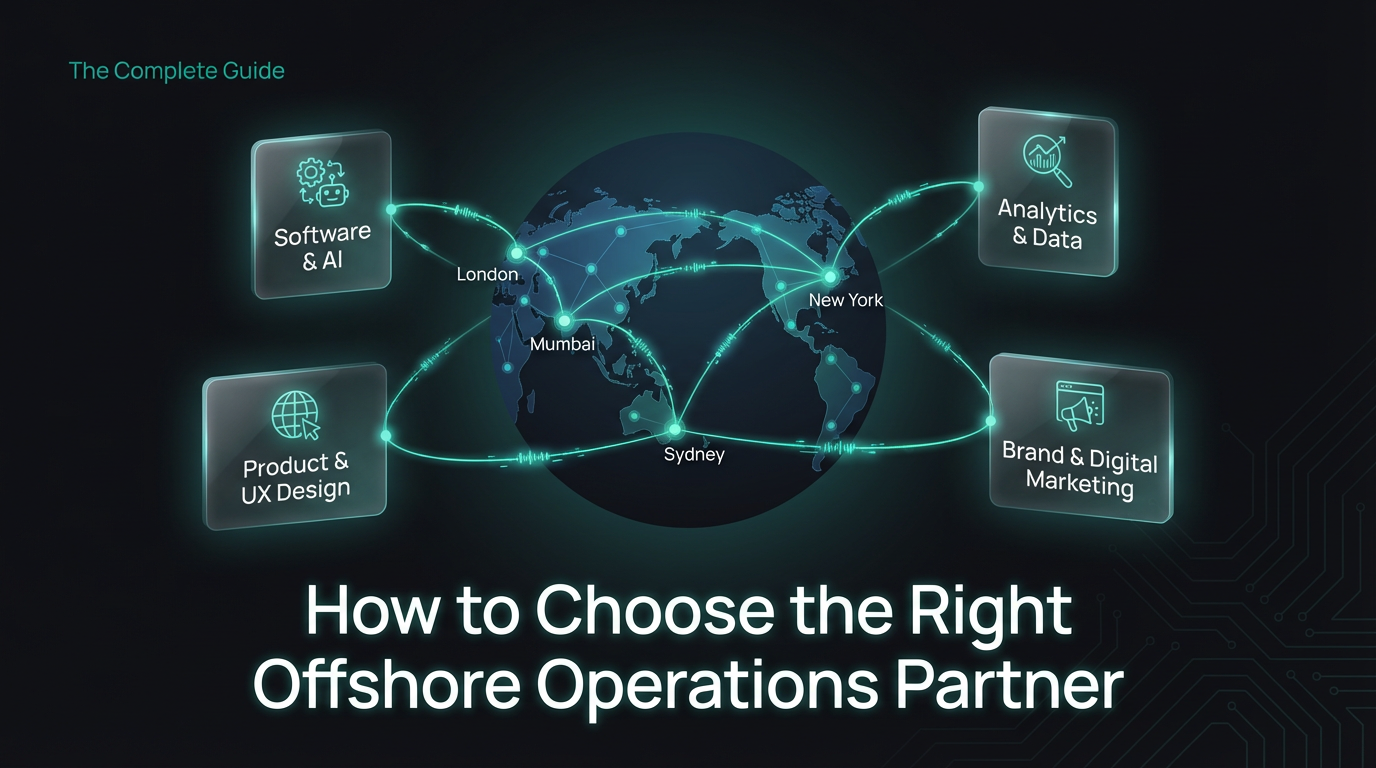
- 1An offshore operations partner helps organisations build and manage teams — software development, analytics, AI, product design, graphic design, brand design, and digital marketing — in talent-rich locations like Mumbai, India.
- 2The best partners go beyond recruitment: they handle legal setup, HR, infrastructure, and ensure your team integrates into your culture and systems from day one.
- 3Before choosing a partner, evaluate their experience with your specific function, their pricing transparency, communication approach, cultural bridging, and whether they genuinely do the heavy lifting.
Offshoring is still viewed as a risky move by many business leaders. They worry about losing control, quality dropping, and communication breaking down.
But that's almost always a partner problem, not an offshoring problem.
The companies that struggle with offshore teams almost universally picked the wrong partner. They chose on price, skipped due diligence, or didn't ask the right questions upfront. The companies that succeed treated partner selection as seriously as hiring a senior executive.
This guide, built from years of building offshore teams across software development, analytics, AI, product design, graphic design, brand design, and digital marketing, covers everything you need to know about what an offshore operations partner does, how to evaluate them, and what separates a great partner from one that will cost you more than it saves.
What is an offshore operations partner?
An offshore operations partner is a company that builds and manages business teams on your behalf in a lower-cost, talent-rich location. Unlike outsourcing agencies that deliver project outcomes, offshore partners build teams that work exclusively for you — your people, your culture, your workflows — just based somewhere else.
The distinction matters. When you outsource a function, you hand off a deliverable and lose visibility into how it's done. When you build an offshore team with the right partner, you retain full control over who's hired, how they work, and what they produce.
A good offshore operations partner handles:
- Recruitment and rigorous vetting of candidates for your specific function
- Legal entity setup and local employment compliance
- Office infrastructure, equipment, and workspace
- HR, payroll, benefits, and day-to-day people management
- Onboarding and cultural integration with your team
- Ongoing engagement to retain top performers
What they don't do — and shouldn't do — is manage the actual work. Your offshore team reports to you. The partner keeps them happy, compliant, and operationally supported.
Offshore operations vs. outsourcing: which model is right for you?
This is one of the most common points of confusion — and one of the most consequential decisions you'll make.
Outsourcing is task-based and transactional. You hand a project or process to a vendor, they deliver it, and the relationship ends or resets. You get a result, but no institutional knowledge stays with your business.
Offshoring through a dedicated partner is relationship-based and long-term. Your team learns your business, your brand standards, your systems. Over time, they become genuinely irreplaceable contributors — not interchangeable resources.
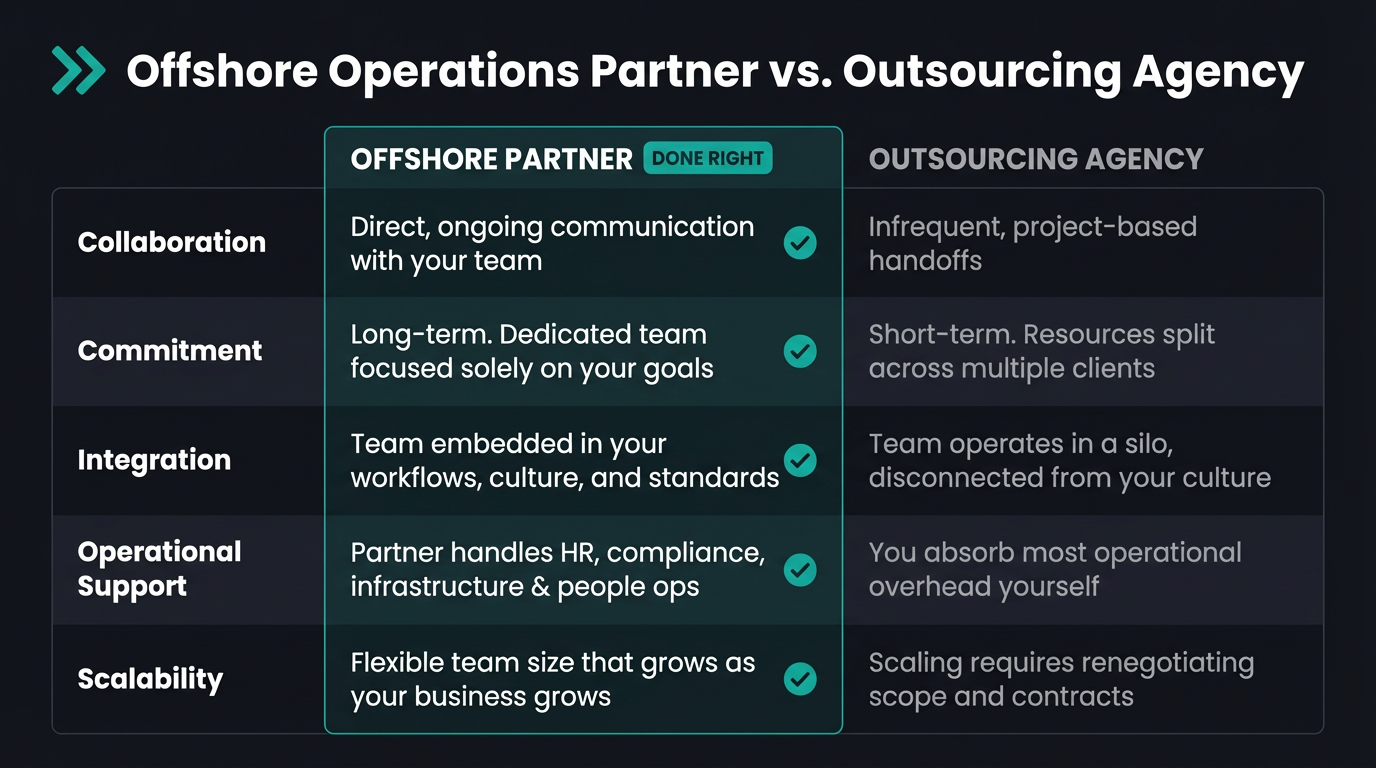
For business-critical functions like software development, product design, or digital marketing — where institutional knowledge and quality consistency compound over time — the dedicated offshore model wins decisively.
How does an offshore operations partnership actually work?
The best offshore partnerships follow a deliberate, structured process. Here's how we approach it at InfAI:
Discovery and qualification
Before anything moves forward, the right partner will invest time understanding your context. Not just what role you're hiring for, but why — what problem you're trying to solve, what you've tried before, and whether offshoring is genuinely the right solution for your situation right now.
A good partner will ask hard questions:
- What pain points are you solving — cost, talent scarcity, speed, or coverage?
- What does success look like in 12 months?
- How mature are your processes and documentation?
- What have you tried before, and why didn't it work?
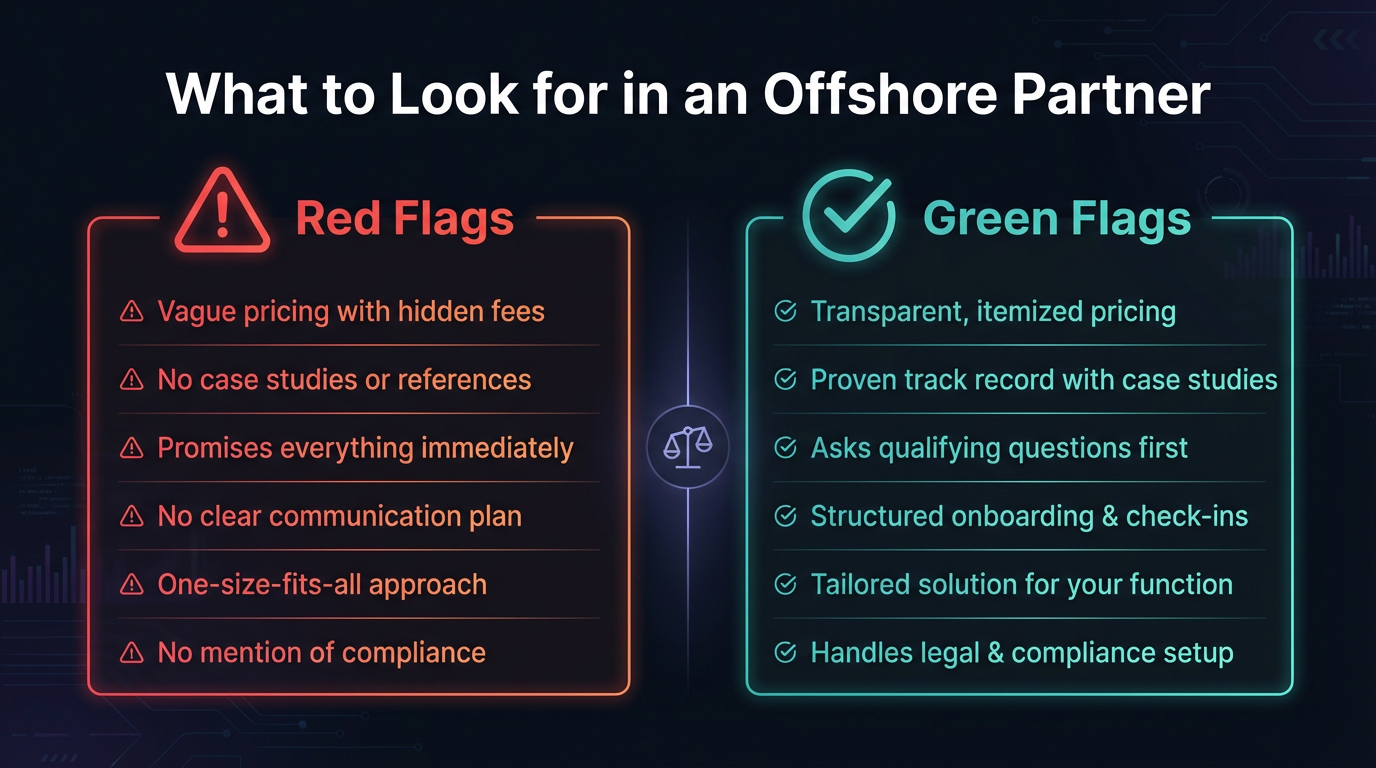
If a partner skips straight to pricing and timelines without this conversation, that's a red flag. Offshoring works best when there's a clear operational foundation — not when it's a quick fix for a chaotic situation.
Solution design
Based on your discovery conversation, a good partner proposes the model that fits your needs — team size, function mix, location, engagement structure, and timeline. This should feel tailored, not templated.
Recruitment and team setup
Your partner handles sourcing, screening, and shortlisting candidates. Your job is final interviews — assessing fit with your team, culture, and quality bar. Simultaneously, your partner prepares the workspace, technology, and onboarding infrastructure.
Integration and onboarding
The first 90 days are critical. Your partner facilitates the integration — communication cadences, tool access, process documentation — while you focus on bringing your new team members into the culture and context of your business.
Ongoing operations management
Once the team is running, your partner stays active in the background: managing HR, handling compliance, running engagement initiatives, and flagging issues before they become problems. You manage the work; they manage the environment.
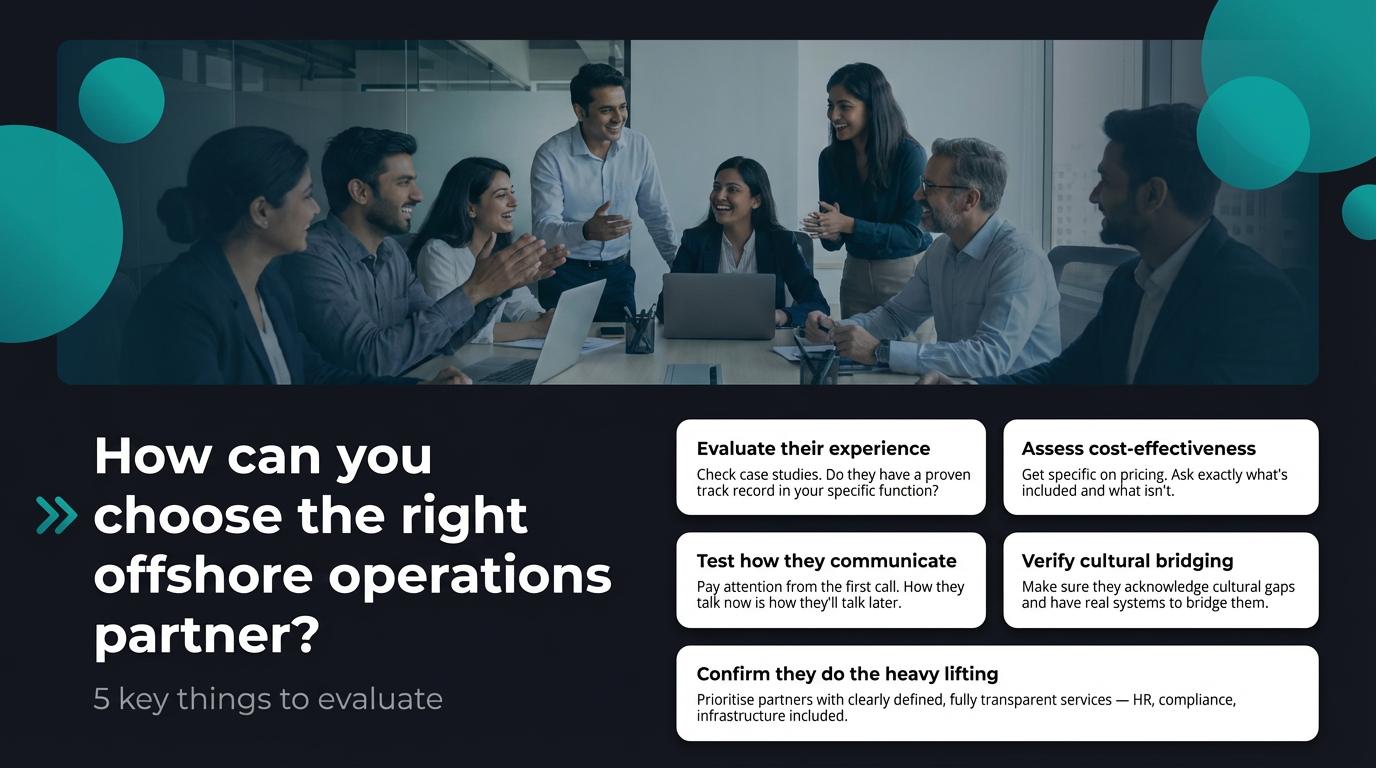
How to choose the right offshore operations partner: 5 key steps
Partner selection is where most offshore failures begin. These five steps will help you cut through the sales noise and identify a partner who will actually deliver.
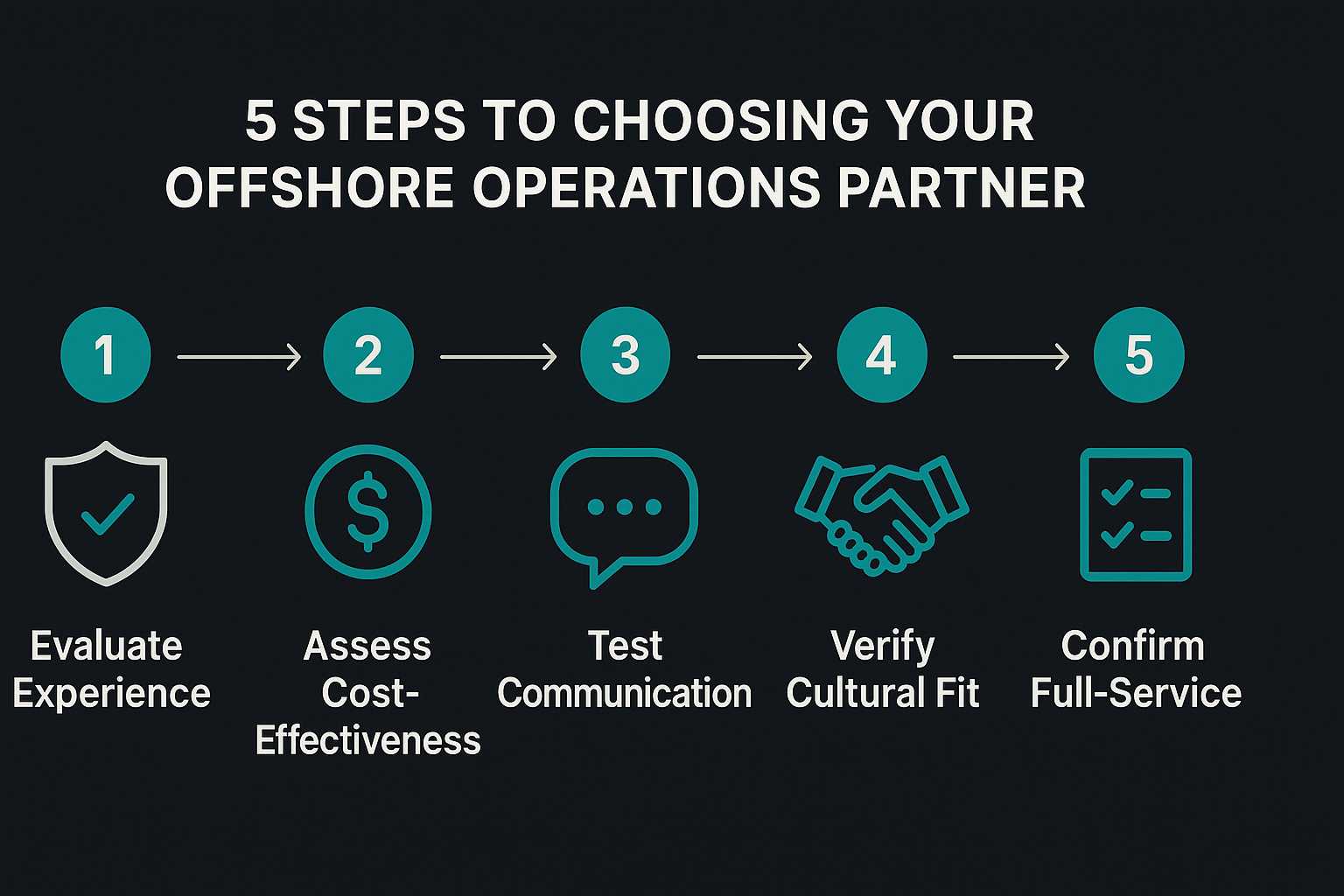
Step 1: Evaluate their demonstrated experience — in your function
Many offshore providers claim to cover every function but are built primarily around one. They know how to recruit engineers but struggle to assess a strong product designer, evaluate an analytics lead, or find a digital marketer who understands Western brand standards.
Ask specifically about their experience in your function:
- Can they show case studies of teams in your exact function (not just tech)?
- Do they have recruiters and assessors with domain knowledge in your area?
- What does their vetting process look like for non-technical roles?
- How do they assess soft skills, communication, and cultural fit for operational roles?
Vague answers here are a warning sign. A partner with real experience in operations will speak concretely about function-specific challenges and how they've navigated them.
Step 2: Assess cost-effectiveness and pricing transparency
One of the core benefits of offshore operations is cost efficiency — companies typically save 35-55% on total operational costs per team member compared to equivalent hires in Western markets. But the lowest quote is rarely the best value.
When evaluating pricing, get specific:
- Is the pricing monthly per person, or does it vary? What's included?
- Are there setup fees, recruitment fees, or infrastructure costs billed separately?
- How does pricing evolve as the team scales?
- Are there minimum contract terms or exit clauses?
A partner who can't give you clear, itemized answers to these questions upfront will almost certainly surprise you with hidden costs later. Pricing transparency is one of the clearest signals of how a partner operates generally.
Step 3: Test their communication approach before you sign
How a partner communicates during sales is a direct preview of how they'll communicate when things get complicated. Pay attention from the first interaction.
Ask about their ongoing communication model:
- Who is your day-to-day point of contact once the team is live?
- How do they handle issues that arise — escalation path, response times?
- What reporting does your partner provide, and how often?
- How do they facilitate communication between your HQ and your offshore team?
The best partners are proactive communicators. They surface problems early, give you useful visibility into your team, and don't leave you chasing status updates.
Step 4: Analyse how they bridge cultural gaps
Culture gaps are real, and they affect every function. A development team that doesn't understand your engineering culture ships the wrong things. A design team that misses Western aesthetic sensibilities produces work that needs constant revision. A digital marketing team that doesn't grasp your brand voice creates content that feels off — these gaps show up in quality and take time to fix.
A good partner doesn't pretend culture gaps don't exist. They have concrete approaches to bridging them:
- Do they have leadership who have lived and worked in both Western markets and India?
- How do they screen for cultural alignment during recruitment?
- Do they offer ongoing cultural training or integration support?
- How do they handle situations where cultural differences create friction?
Hesitance or vagueness on this topic is a warning sign. Partners who acknowledge cultural nuances and have built systems to address them are the ones who deliver consistent quality long-term.
Step 5: Confirm they actually do the heavy lifting
This one sounds obvious, but it trips up many companies. A partner may promise full-service in their pitch — HR, compliance, infrastructure, ongoing management — but bury carve-outs in the contract or charge for everything separately.
Before signing, verify explicitly:
- Who handles payroll, benefits, and statutory compliance?
- Who manages the physical workspace and IT infrastructure?
- Who is responsible for performance management and retention?
- What happens if a team member leaves — who handles backfill recruitment and at what cost?
A partner who genuinely does the heavy lifting will answer these questions without hesitation and with specifics. One who hedges or redirects is almost certainly offloading more than you expect.
Questions to ask any offshore operations partner before committing
Beyond the five evaluation steps, these questions will quickly reveal whether a partner is the real deal or just a polished sales operation:
Where exactly do you source talent, and why?
The answer should be specific — not just "India" but which city, which talent communities, which institutions or industries. A partner building operations teams in Mumbai should explain why Mumbai produces better operations talent than Bangalore or Delhi, not just say "we have access to great talent."
What does your recruitment process look like for non-technical roles?
Generic answers about resumes and interviews won't cut it. The right partner will describe function-specific assessment approaches: how they run technical interviews and code reviews for dev hires, how they evaluate analytical thinking and data modelling for analytics roles, how they assess portfolio quality and brand sensibility for design and marketing candidates.
Are your team members exclusively dedicated to my business?
Some partners quietly share team members across clients, especially in early stages. Your offshore team should work exclusively for you — not juggle your operations with three other companies' projects.
Can I speak to a current client in a similar function?
A partner confident in their track record will facilitate reference calls without hesitation. If they resist, push back, or can only offer written testimonials, that's meaningful.
Pro tip: The best offshore operations partners will sometimes tell you they're not the right fit — yet. If your processes are undocumented, your team structure is in flux, or you're looking for a short-term fix, an honest partner will say so. That directness is a feature, not a flaw.
Why InfAI is a trusted offshore operations partner
At InfAI, we build dedicated offshore operations teams in Mumbai — the commercial and financial capital of India. Our focus isn't just on filling seats; it's on building teams that become genuine operational assets for our partners.
What makes our approach different:
- We specialise in software development, analytics, AI, product design, graphic design, brand design, and digital marketing. Our recruiters have genuine domain expertise in each function — not just generalist hiring skills.
- Mumbai gives our partners a genuine edge. The city's commercial heritage creates professionals with business acumen, not just task-execution skills. Lower attrition, stronger judgment, deeper institutional loyalty.
- We handle everything after hiring. Infrastructure, compliance, HR, payroll, benefits, and day-to-day team management — so you can focus entirely on managing the work itself.
- We're selective about who we work with. If we don't think offshoring is the right solution for your current situation, we'll tell you — and explain what needs to change before it makes sense.
Ready to explore whether an offshore operations team is right for your business? Reach out and one of our senior team members will get back to you for an honest, no-pressure discovery call.
FAQs
A staffing agency finds candidates and places them — then steps back. An offshore operations partner builds and actively manages your team long-term, handling HR, compliance, infrastructure, and engagement. The difference shows up in quality, retention, and how well your team integrates with your business over time.
Most companies save 35-55% on total operational costs per team member compared to equivalent hires in the US, UK, or Australia. For roles in cities like London or San Francisco, savings can reach 60-65%. These aren't just salary differences — they include benefits, office costs, recruitment fees, and management overhead that your partner absorbs.
From initial kick-off, most functions are operational within 30-60 days for initial hires. Software development and analytics roles typically take 45-60 days due to the depth of technical vetting required. Design and digital marketing roles can often move faster given portfolio-based assessment. Your partner should give you a clear timeline at the start of the engagement.
Your partner is responsible for managing attrition and backfilling roles. A good partner will have proactive retention programmes that keep attrition low (under 12% annually is achievable with the right approach). When someone does leave, replacement recruitment should begin immediately — ideally before the departure — with minimal disruption to your operations.
Absolutely. Most companies start with 2-5 people to establish workflows and prove the model, then scale once confidence is established. This approach minimises risk while building operational knowledge. Your partner should be able to support rapid scaling — from 5 to 50 — without the quality or culture degrading.
The same way you maintain quality with any team: clear processes, regular feedback, defined quality benchmarks, and strong communication cadences. Your offshore partner handles the environment; you handle the work standards. Partners who invest in integration — not just placement — produce consistently higher quality output.
Reputable offshore partners have robust security infrastructure — NDAs, restricted-access environments, ISO-compliant data handling, and clear IP ownership clauses. Before signing, ask specifically about their data security certifications, how they handle sensitive information, and what your contractual protections are.
For business operations — finance, support, creative, back-office — Mumbai consistently outperforms Bangalore. The city's commercial ecosystem produces professionals with inherent business acumen, not just technical execution skills. Attrition is also significantly lower, which matters enormously for functions where institutional knowledge compounds over time.
Build Your Team, Not Just a Contract
With InfAI's offshore dedicated teams, you get professionals who join your workflow for the long run. Grow steadily, stay flexible, and work with people who care about your success as much as you do.