
India vs Philippines vs Eastern Europe: Where to Build Your Offshore Team
A data-driven comparison of the world's top offshore destinations. Make the right choice for your specific needs.

Key Takeaways
- 1There's no universally "best" offshore destination—the right choice depends on your specific needs, budget, and work type.
- 2India leads for technical depth and scale; Philippines excels at customer-facing roles; Eastern Europe offers proximity for European companies.
- 3Total cost includes more than salaries—factor in attrition, management overhead, and ramp time.
The question I hear most often from executives considering offshore teams is deceptively simple: "Where should we go?" They want a straightforward answer—India, Philippines, or maybe Poland—with a clear rationale that can be summarized in a board presentation. The honest answer, which is less satisfying but more useful, is that the question itself is backwards. The right question isn't "where should we go?" but rather "what are we trying to accomplish, and which location best serves that specific goal?"
This isn't semantic nitpicking. The framing matters because each major offshore destination has evolved to serve particular needs exceptionally well, while serving other needs poorly or not at all. India didn't become the world's back office by accident; the Philippines didn't dominate voice customer service by coincidence; Eastern Europe didn't attract product engineering work randomly. Each destination represents decades of investment, education pipeline development, and market feedback that shaped its strengths.
India: The Deep Bench
India's proposition is fundamentally about depth and scale. The country produces over 1.5 million engineering graduates annually, creating a talent pipeline that no other nation can match. This scale enables something that sounds mundane but is actually transformative: specialization without scarcity. Need developers with experience in a particular legacy system that your company can't find locally? India probably has hundreds of them. Need accountants who understand both US GAAP and IFRS? India has thousands. Need designers who've worked specifically on enterprise B2B SaaS products? India has them too.
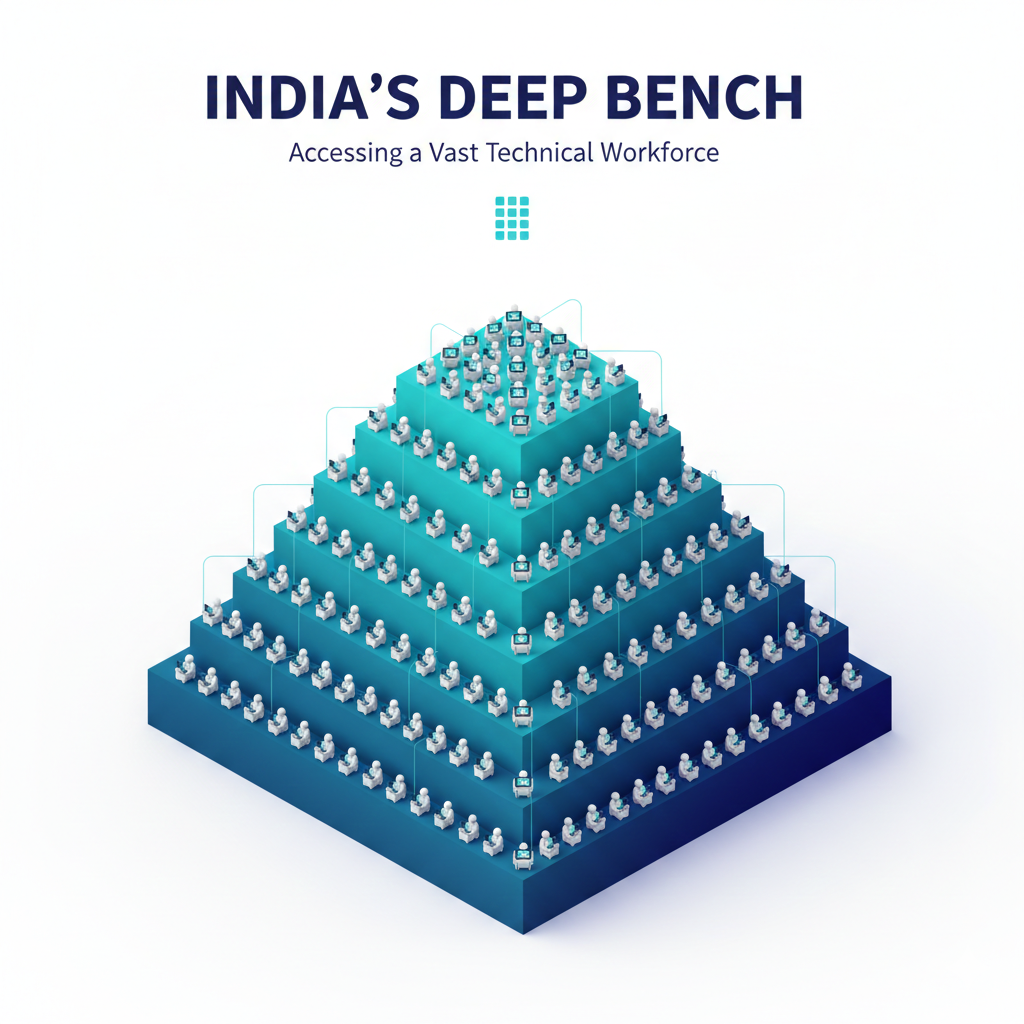
This depth comes with a cost: variance. The gap between an excellent Indian professional and a mediocre one is wider than you'll find in smaller, more homogeneous talent markets. The top 10% of Indian talent competes globally and commands salaries that, while still lower than Western equivalents, aren't the 70% discount that headlines promise. The bottom quartile will produce work that costs more to fix than it saves. The implication is clear: success in India is entirely a function of selection. The country has world-class talent available; accessing it requires either deep local knowledge or a partner who has it.

The city you choose within India matters more than most companies realize. Bangalore has the deepest technical talent but also the highest costs and most aggressive poaching. Mumbai offers business-minded professionals who understand context—ideal for operations requiring judgment, not just execution. Hyderabad and Pune provide strong technical talent at lower costs than Bangalore, with somewhat less competition for top performers. Chennai has excellent process-oriented workers but a more conservative business culture. Each city has its own character, and matching your needs to that character improves outcomes significantly.
“The right Indian team can outperform your local team at half the cost. The wrong Indian team will cost you more than you save. The difference is entirely in how you build and manage.
Philippines: The Voice of Your Company
The Philippines' dominance in customer-facing operations stems from a cultural accident that became an economic strategy. American colonial influence created English as a national language, but more importantly, it created cultural fluency that goes beyond words. Filipinos grew up watching American television, listening to American music, and absorbing American social norms. When a Filipino customer service representative speaks to an American caller, the cultural alignment is natural in a way that requires significant training to achieve elsewhere.
This cultural alignment manifests in ways that are hard to measure but easy to feel. Filipino representatives intuitively understand American customer expectations around politeness, directness, and resolution. They pick up on cultural references that would confuse representatives from other backgrounds. They navigate sensitive conversations—billing disputes, service failures, emotional customers—with an instinct for what American callers need to hear. For voice-based customer service targeting North American markets, no other destination comes close.
The Philippines' limitations are the inverse of its strengths. The technical talent pool is smaller and shallower than India's—not because Filipinos lack capability, but because the education system and market demand have pushed development in different directions. Infrastructure outside Metro Manila can be unreliable. The capacity for very large operations (500+ people) is more constrained than in India. For technical work, process operations, or back-office functions that don't involve customer interaction, the Philippines' premium for cultural alignment becomes a cost without corresponding benefit.
Eastern Europe: The Quality Ceiling
Eastern Europe represents a fundamentally different trade-off: higher cost for higher average quality. A senior developer in Poland or Romania costs 50-100% more than an equivalent Indian developer, but that premium buys real differences in working style and output.
The first difference is autonomous problem-solving. Eastern European developers—shaped by educational systems that emphasize theory and first-principles thinking—are more likely to question requirements, propose alternatives, and solve problems you didn't know to ask about. This is invaluable for product engineering where the right answer isn't predetermined; it's less valuable for well-defined process work where following specifications matters more than challenging them.
The second difference is cultural proximity to Western Europe. Similar business norms, overlapping working hours, easy travel (within the EU), and shared cultural references reduce friction in ways that compound over time. For European companies especially, the smoothness of collaboration with Polish or Romanian teams often justifies the premium over Asian alternatives. For American companies, this proximity advantage is weaker, tilting the calculus back toward cost optimization.
The third difference is attrition. Eastern European technology markets are smaller and, until recently, less hypercompetitive than India's. Developers change jobs less frequently, institutional knowledge accumulates, and the total cost of employment—including recruiting and training—ends up closer to Indian costs than salary figures suggest. This attrition advantage has eroded somewhat as remote work expands opportunities for Eastern European developers, but it remains meaningful.
Many companies successfully operate in multiple destinations—using each for what it does best. India for engineering, Philippines for support, for example.
The Hidden Cost Model
The most common mistake in offshore destination selection is optimizing for headline salary costs while ignoring total cost of employment. Salary is the largest component, but several other factors significantly affect actual economics.
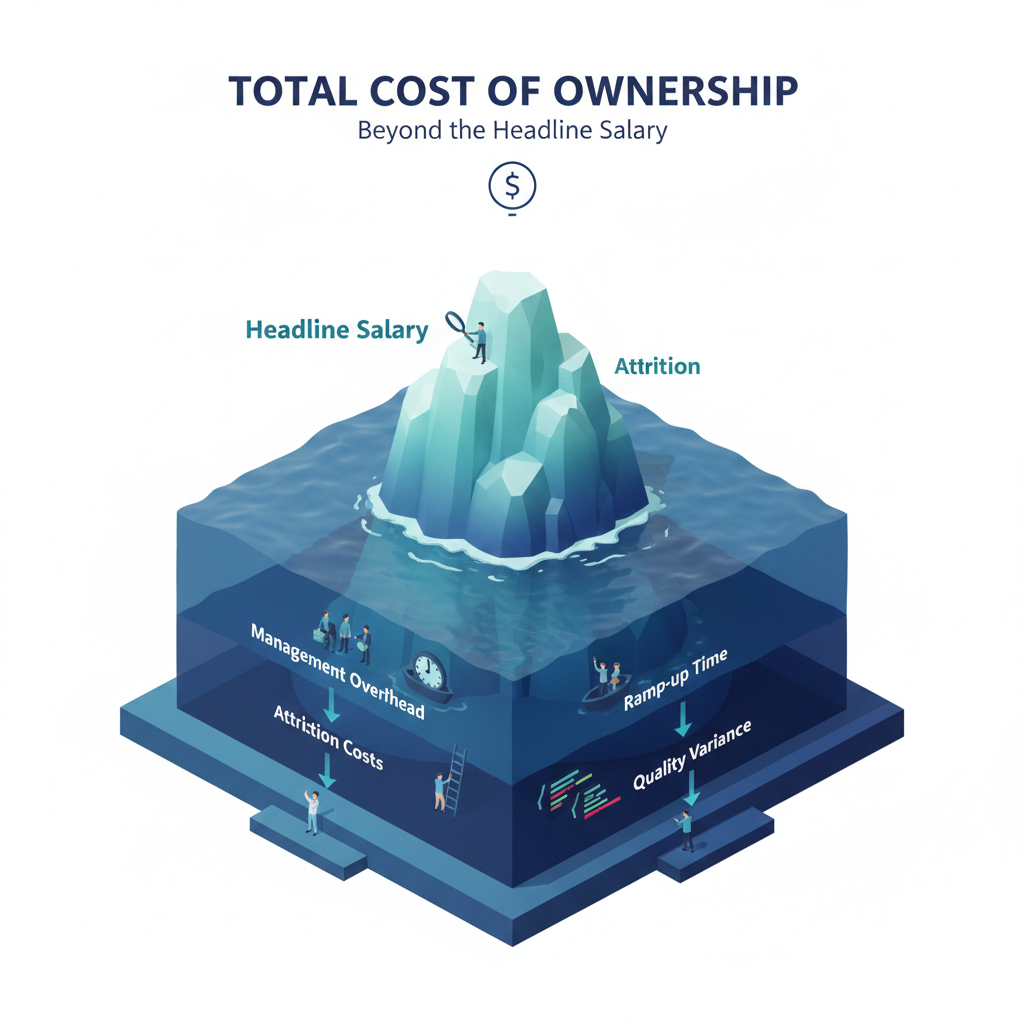
Attrition is the silent killer of offshore savings. Indian BPO operations routinely see 30-40% annual turnover; Indian technology teams see 15-20%. Philippine operations typically range 25-35%. Eastern European teams might see 10-15%. Each departure triggers recruiting costs, training costs, productivity losses during ramp-up, and potential quality issues as new people learn the work. A 35% attrition rate means you're essentially recruiting and training your entire team every three years; the cost compounds.
Management overhead varies by destination in ways that aren't obvious from salary data. Some offshore teams require more hands-on guidance, more explicit processes, and more frequent check-ins. These costs appear in your headquarters headcount, not your offshore budget, but they're real. A team that needs a full-time US manager and weekly video calls has different economics than a team that operates independently with monthly reviews.

Ramp time affects when you start realizing savings. India offers the fastest ramp—45-60 days for small teams—thanks to abundant talent and mature recruiting infrastructure. Philippines takes longer, typically 60-90 days. Eastern Europe, especially for specialized roles, might require 90-120 days. If you need results quickly, this timing difference matters for your business case.
Making the Decision
The framework for decision is straightforward once you accept that there's no universally correct answer. For software engineering at scale, India is almost always the right choice—the depth of talent is simply unmatched. For voice-based customer support serving North American markets, the Philippines dominates. For European companies building product engineering teams where quality and cultural fit outweigh cost optimization, Eastern Europe makes sense.
The harder decisions come in the middle cases. What about technical support that's partially voice-based? What about operations teams that need both scale and customer interaction? What about companies that want cost savings but can't tolerate the attrition common in lower-cost locations? These cases require honest assessment of priorities rather than following conventional wisdom.
At InfAI, we built in Mumbai because our clients need business operations requiring judgment—finance, analytics, creative work that understands context. Mumbai's talent pool fits this need better than pure technology hubs. But we advise clients regularly that other destinations might serve their specific needs better. The goal isn't to win business; it's to help companies build teams that actually work. Sometimes that means us, and sometimes it doesn't.
FAQs
Yes, but it's expensive and disruptive. Better to choose carefully upfront. If you're uncertain, consider a small pilot in your top two choices before scaling.
Vietnam is growing fast for software development with lower costs than India. Mexico offers "nearshore" benefits for US companies—similar timezone, easier travel. Both are worth considering for specific use cases.
Extremely important. A great partner in a "suboptimal" location will outperform a poor partner in the "perfect" location. Vet partners carefully regardless of where you go.
Yes, strongly recommended. Seeing operations firsthand, meeting potential team members, and understanding the local culture provides insight that research can't replicate.
Depends on destination and partner. Generally, 5-10 people is a reasonable starting point. Smaller teams often don't justify the setup and management overhead.
Build Your Team, Not Just a Contract
With InfAI's offshore dedicated teams, you get professionals who join your workflow for the long run. Grow steadily, stay flexible, and work with people who care about your success as much as you do.