
Knowledge Transfer to an Offshore Team: A 5-Phase Plan That Avoids the Productivity Dip
Most offshore transitions do not fail on talent. They fail in the handover. Here is a practical 5-phase knowledge transfer plan, with the exit criteria that tell you when the new team is truly ready.

Key Takeaways
- 1Offshore transitions rarely fail because the new team lacks skill. They fail because the knowledge that makes the work run lives in a few people's heads, and nobody planned how to move it.
- 2A structured knowledge transfer runs in five phases: map the work, document it, let the offshore team shadow, then reverse the roles, and only hand over when clear exit criteria are met.
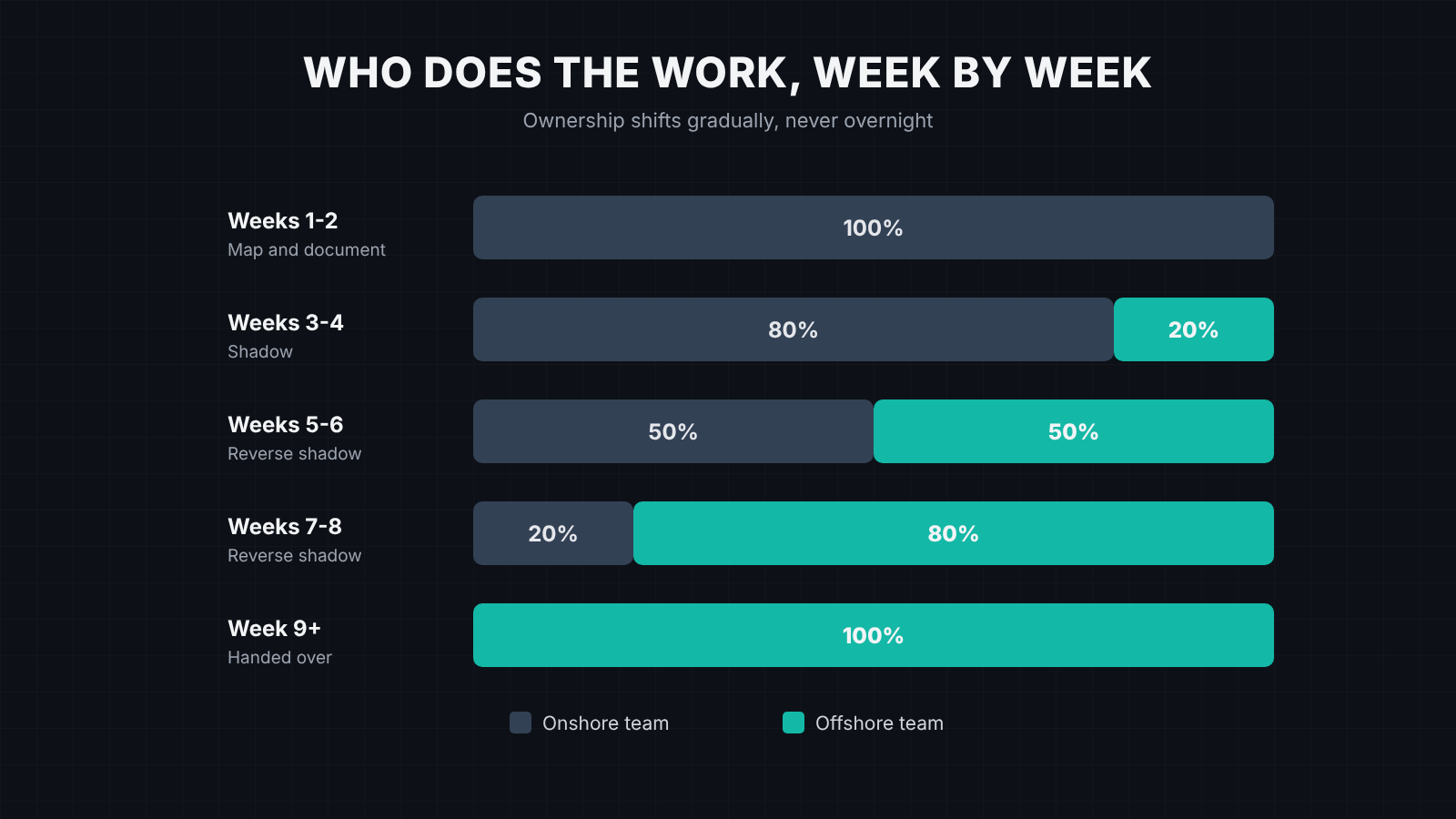
- 3Plan for six to ten weeks of overlap for most functions. Cutting the overlap short is the single most common cause of the productivity dip that makes leaders regret offshoring.
Every offshore transition has a moment of truth. The new team is hired, the laptops are shipped, the kickoff call went well. Then the first real week of work arrives, and it becomes clear how much of the job was never written down.
The supplier who always sends invoices in the wrong format. The report that needs a manual fix every month-end. The customer who must be called, never emailed. None of it is in a process document. All of it is in someone's head.
This is where most of the horror stories about offshoring come from. Not from a lack of talent, but from a rushed, unstructured handover that leaves a capable team guessing.
The fix is a proper knowledge transfer plan. This guide lays out the five-phase approach we use when we take over work for clients, how long each phase should take, and the checklist that tells you when the new team is genuinely ready to own the work.
Why knowledge transfer is where offshore transitions succeed or fail
Most companies plan the hiring side of an offshore move carefully and the handover side barely at all. The typical plan is a few weeks of video calls, a shared drive of old documents, and a go-live date. That is not a knowledge transfer. It is a hope.
Three things make the handover harder than it looks:
- Tacit knowledge. The most valuable know-how is the stuff people do without thinking: judgement calls, workarounds and exceptions. It rarely makes it into documentation unless someone deliberately draws it out.
- Departing experts. If the people who hold the knowledge are leaving or moving roles, their motivation to transfer it well can be low. You need their time protected and their incentives aligned.
- Volume pressure. Work does not stop during a transition. If the onshore team is still fully loaded, knowledge transfer becomes the thing that gets squeezed.
The 5-phase knowledge transfer plan
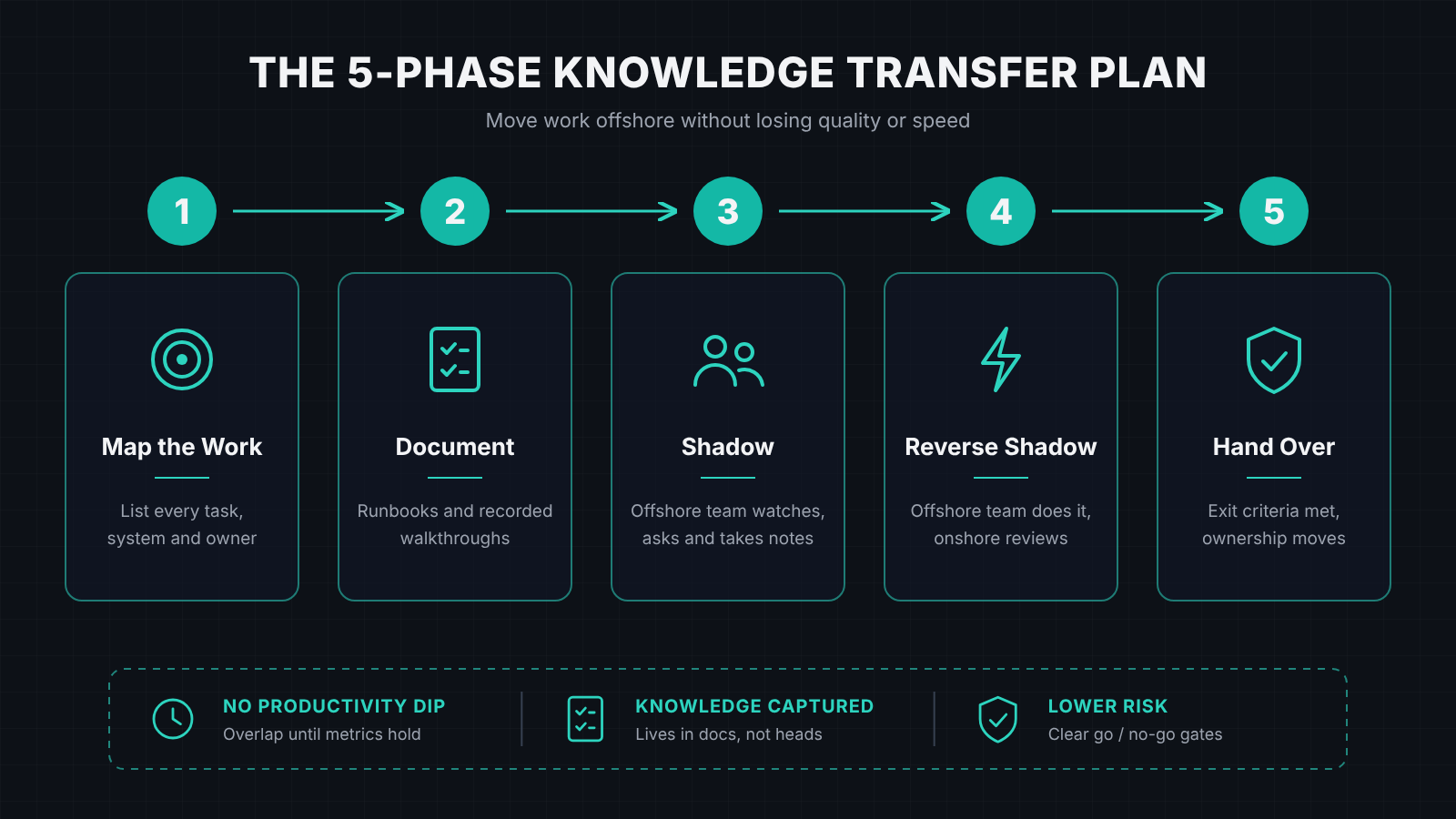
Phase 1: Map the work
Before anyone documents anything, build an inventory. List every recurring task, the systems it touches, how often it happens, who does it today and how critical it is. Include the irregular work too: month-end, quarter-end, annual audits and seasonal peaks.
Rank each task by volume and risk. High-volume, low-risk tasks transfer first and build confidence. High-risk tasks, such as anything touching payments, compliance or key customers, transfer last and with the longest overlap.
Phase 2: Document it properly
Good transition documentation is short, practical and close to the work. For each task you want a runbook: the trigger, the steps, the systems, what good output looks like, and the most common exceptions with how to handle them.
The fastest way to capture tacit knowledge is to record it. Ask the current owner to talk through the task on a screen recording as they do it for real. Ten minutes of narrated video often captures more than a ten-page document, and the offshore team can turn it into a written runbook as their first learning exercise.
Pro tip: Have the offshore team write the runbooks from the recordings, then have the current owner review them. Writing forces understanding, and the review catches gaps before they become live mistakes.
Phase 3: Shadow
In the shadow phase, the onshore owner still does the work and the offshore team watches, asks questions and takes notes. This is when the "why" behind each step comes out, which is exactly the knowledge that never makes it into documents.
Keep a shared log of every question asked and every answer given. By the end of shadowing, that log is often the most useful document in the whole transition.
Phase 4: Reverse shadow
Now the roles flip. The offshore team does the work and the onshore owner reviews it before it goes out. This is the most important phase and the one most often cut short.
Reverse shadowing is where confidence is built on evidence. Track error rates, turnaround times and how often the reviewer has to step in. As those numbers settle, the reviewer moves from checking everything to spot-checking a sample.
Phase 5: Hand over
Handover is a decision, not a date. It happens when the offshore team meets agreed exit criteria, not when the calendar says so. After handover, keep a named onshore contact for escalations for at least a month, and run a short review at 30 days to catch anything that slipped through.
“The companies that get offshore transitions right treat handover as a gate the new team earns, not a date on a project plan. The extra two weeks of overlap cost far less than a quarter of firefighting.
How to know the team is ready: the handover checklist
Agree the exit criteria at the start of the transition, so nobody is debating them under pressure at the end. A practical set looks like this:
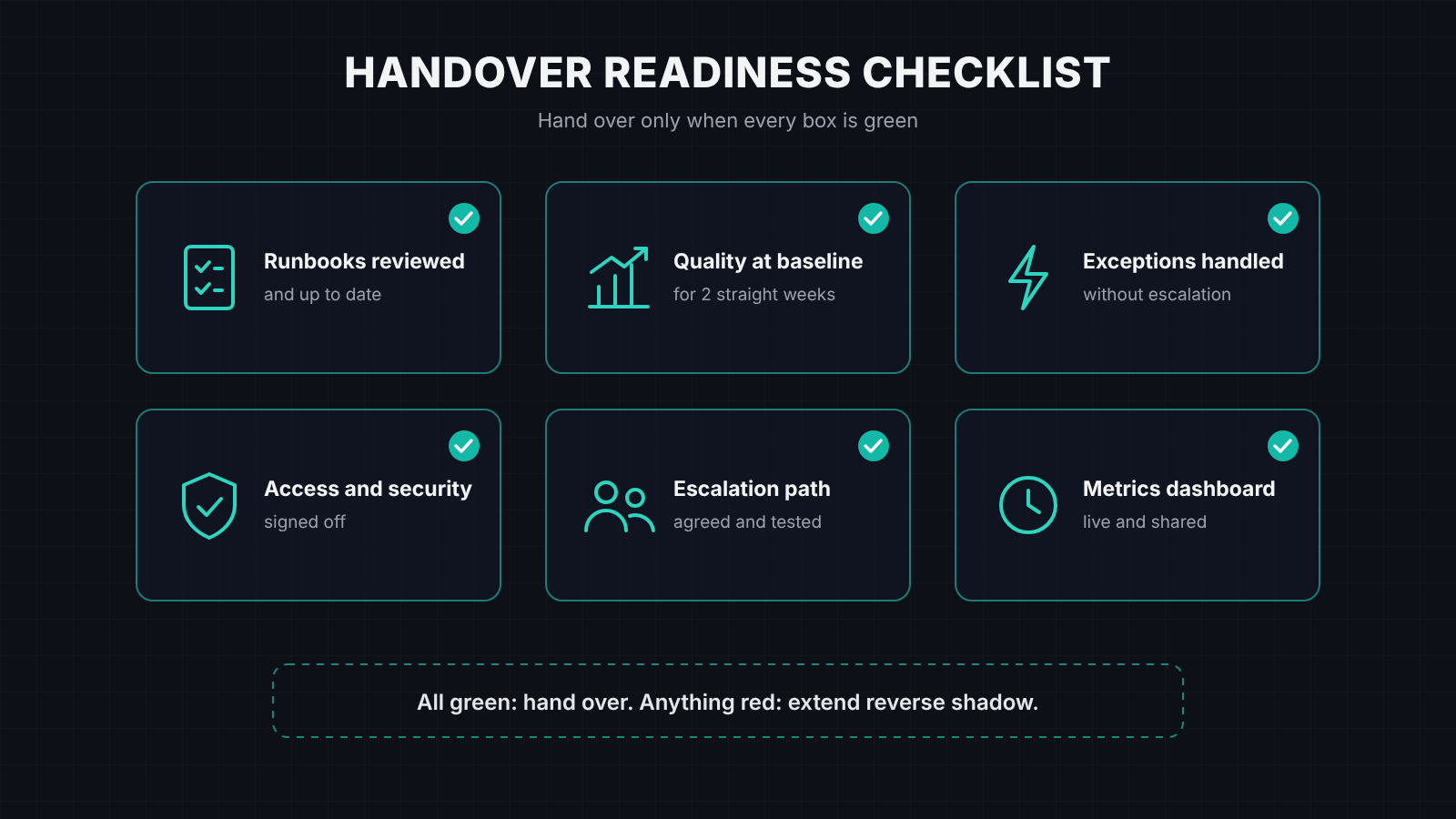
- Runbooks for every task are written, reviewed by the current owner and up to date.
- Quality and turnaround have matched the onshore baseline for at least two consecutive weeks.
- The team has handled real exceptions without needing to escalate.
- System access and security controls have been reviewed and signed off.
- An escalation path is agreed, documented and has actually been tested.
- A metrics dashboard is live and shared, so both sides see the same numbers.
Common knowledge transfer mistakes
- Setting the go-live date before the plan. Fix the phases and exit criteria first, then work out the date.
- Skipping reverse shadowing to save time. It is the phase that catches the mistakes you cannot see in documents.
- Leaving the current owners fully loaded. Free up a meaningful share of their time during the transition, or the transfer will lose every priority contest.
- Transferring everything at once. Move work in waves, starting with high-volume, low-risk tasks.
- Ending support on handover day. Keep an onshore point of contact and a 30-day review in place.
How InfAI runs knowledge transfer for clients
At InfAI, knowledge transfer is part of how we build every team, not an afterthought. Before the Mumbai team takes on any work, we agree the task inventory, the phase plan and the exit criteria with the client. Our team writes the runbooks, runs the shadow and reverse shadow phases, and tracks quality against the client's baseline throughout.
The result is a handover that feels uneventful, which is exactly how it should feel. The work keeps flowing, the knowledge ends up documented rather than locked in a few people's heads, and the client gets a team that owns the process from week one of handover.
If you are planning to move work offshore and want a transition that does not disrupt your operations, we would be happy to walk you through how we would structure the knowledge transfer for your team.
FAQs
For most finance, operations, support and engineering functions, plan for six to ten weeks of overlap from mapping to handover. Simple, high-volume work can move faster. Complex or regulated work, or anything with irregular cycles such as quarter-end, can take longer.
Reverse shadowing is the phase where the new team does the work and the current owner reviews it before it goes out. It turns knowledge into proven ability, and it is the best predictor of a smooth handover.
Start with them. Prioritise recording their tasks early, protect their time during the transition, and consider a retention or completion bonus tied to a successful handover. Their cooperation is worth far more than it costs.
No. Map the work first, but let the offshore team write most of the documentation from recordings and shadowing. It is faster, and the team learns the work far better by writing it down themselves.
Agree a baseline before you start: accuracy, turnaround time, volume handled and escalations. Track the same numbers through reverse shadowing and for at least 30 days after handover. If they hold, the transfer worked.
Build Your Team, Not Just a Contract
With InfAI's offshore dedicated teams, you get professionals who join your workflow for the long run. Grow steadily, stay flexible, and work with people who care about your success as much as you do.