
The Remote Team Playbook: Managing Distributed Teams Across Time Zones
Master the art of managing teams across continents. Proven frameworks for communication, collaboration, and culture that actually work.
Key Takeaways
- 1Successful remote team management requires intentional systems—it doesn't happen by accident.
- 2The biggest remote team killer isn't time zones; it's lack of clarity and context.
- 3Companies that master distributed work gain access to global talent while reducing costs by 40-60%.
There's a particular kind of executive who, upon hearing that their new offshore team is 10,000 kilometers away, immediately starts thinking about surveillance software. They want to know when people log in, how long they're active, and whether that little green dot in Slack is genuine or spoofed. This instinct is understandable—and completely wrong.
The fundamental insight about managing remote teams is that you cannot replicate the office. The sooner you accept this, the sooner you can build something better. The office provides ambient awareness: you see when people arrive, you notice who's talking to whom, you sense when energy is high or when something's wrong. None of this translates to distributed work. Attempting to recreate it through monitoring tools and constant video calls doesn't give you the benefits of the office—it gives you the worst of both worlds.
What does translate is output. Work product. Deliverables. The shift from presence-based management to output-based management is the single most important mental model change for anyone leading a distributed team. It sounds obvious when stated plainly, but the implications are profound and most organizations resist them.
The Mindset Shift: From Presence to Output
Consider what happens in a traditional office when a manager wants to know how a project is going. They walk over to someone's desk, glance at their screen, ask a few questions, and get a sense of progress. The interaction takes two minutes and provides useful information. Now consider the remote equivalent: the manager sends a Slack message, waits for a response (which might come in minutes or hours, depending on the recipient's focus time), schedules a call if the text exchange isn't sufficient, and eventually gets the same information—but with far more friction and far more interruption to the employee's workflow.
The solution isn't to add more technology to approximate that two-minute desk visit. The solution is to eliminate the need for it entirely. This means defining work in terms of outcomes, not activities. It means establishing rhythms of communication that provide visibility without requiring constant interruption. It means trusting people to do their jobs—and building systems that make trust possible.
“If you don't trust your remote team to work without constant oversight, you either have the wrong people or the wrong systems. Fix one of those—don't add more monitoring.
The practical implications are significant. Every role needs clearly defined deliverables—not tasks to complete, but outcomes to achieve. "Process invoices" is a task; "Ensure all invoices are processed within 48 hours with less than 1% error rate" is an outcome. The former requires monitoring to verify compliance; the latter can be measured and reported on without any surveillance at all.

The Architecture of Communication
Communication in distributed teams isn't just more important than in co-located teams—it's fundamentally different in kind. The default mode must be asynchronous. This isn't a nice-to-have; it's a structural requirement imposed by the reality of time zones and the nature of knowledge work.
Asynchronous communication has properties that, once understood, become advantages rather than limitations. A well-written document can be read and processed by anyone, at any time, without requiring the author's presence. It creates a record that can be referenced later. It allows the recipient to engage with the content when they're in the right mental state, not when the sender happens to be available. It forces the communicator to think through their message completely before sending it, rather than working through their thoughts in real-time conversation.
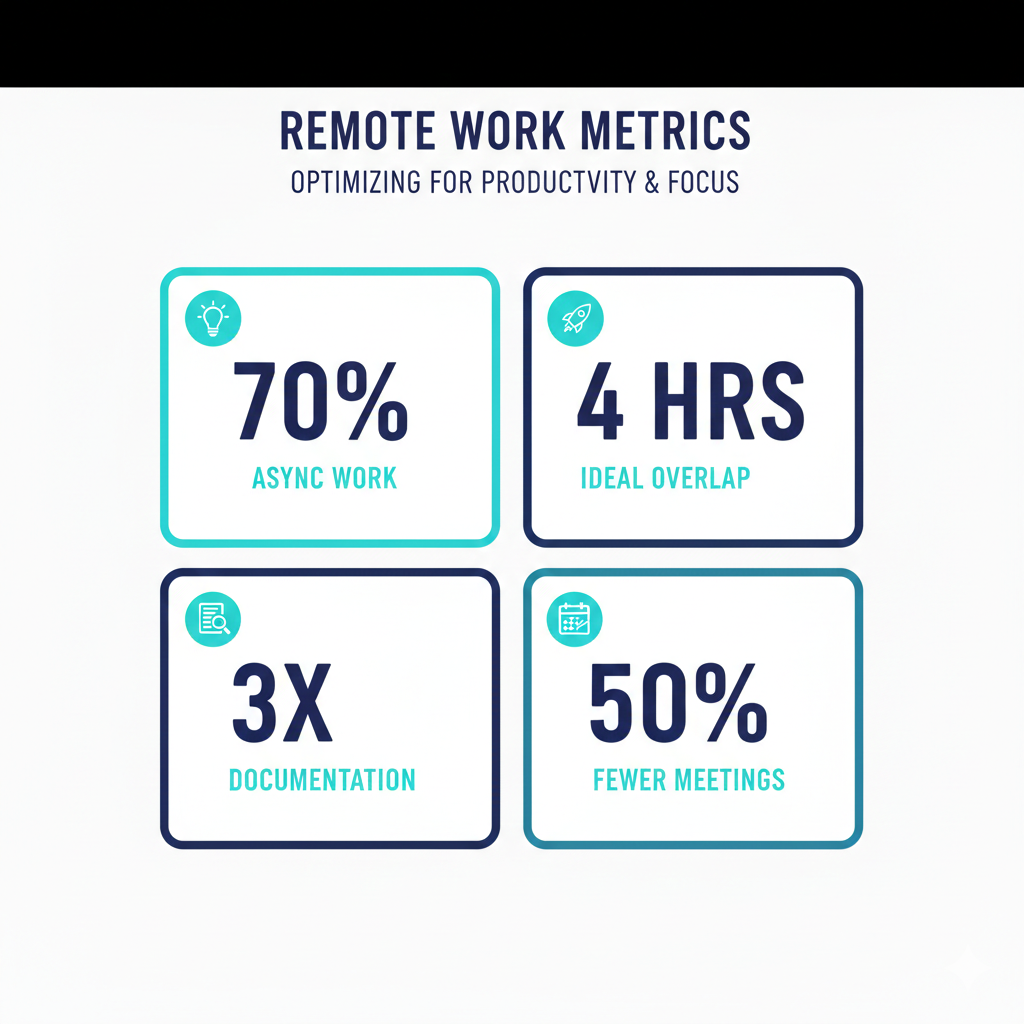
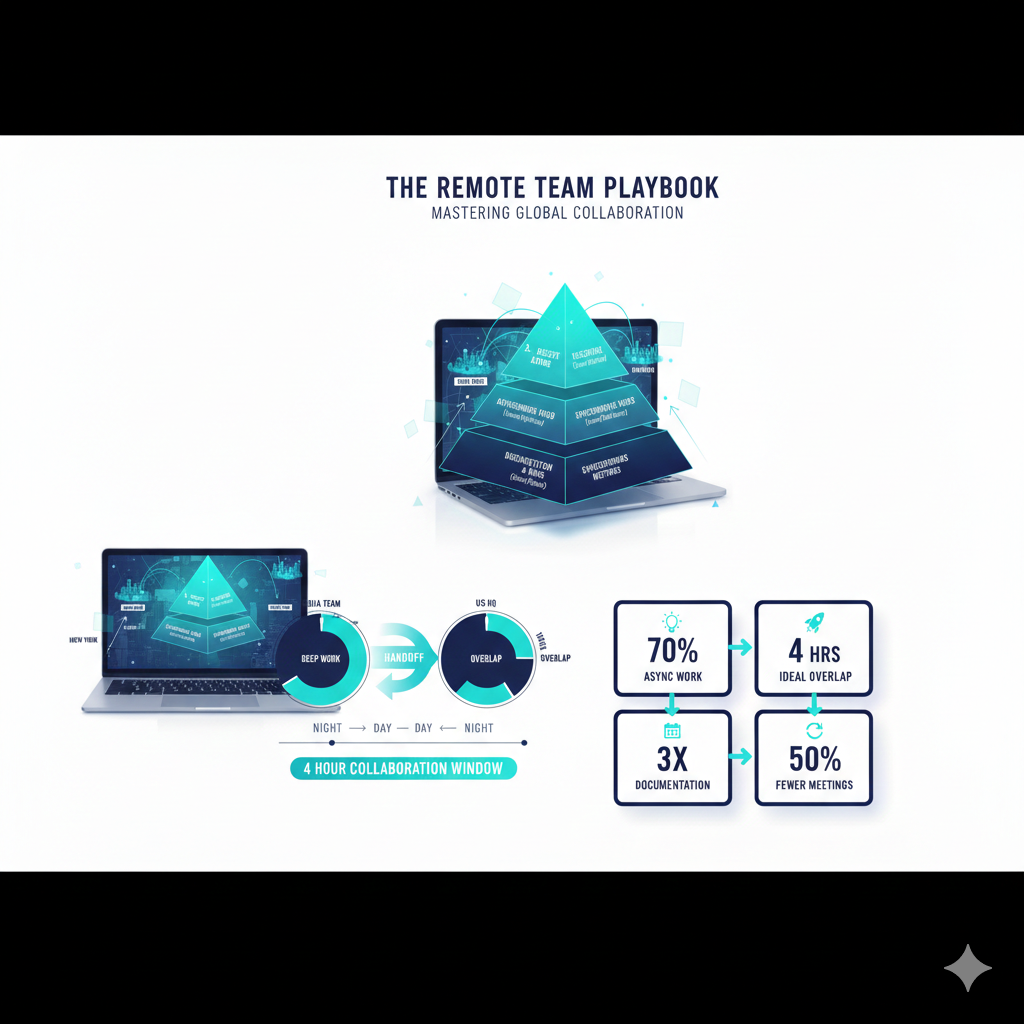
The corollary is that synchronous time becomes precious and must be used deliberately. If your team in Mumbai overlaps with New York for three hours each day, those hours should be reserved for activities that genuinely require real-time interaction: relationship building, complex problem-solving, sensitive conversations, collaborative brainstorming. Anything that can be accomplished asynchronously should be, freeing the overlap window for what matters most.
This creates a rhythm that many distributed teams find more effective than traditional office work. Deep work happens during non-overlap hours, when no one is pinging you for quick questions. Collaborative work happens during overlap hours, when real-time interaction is possible. The key is intentionality: knowing which mode you're in and organizing work accordingly.

Building Culture Without Proximity
The skeptics always raise culture. "How do you build culture when people never see each other?" The question contains a flawed assumption: that culture is a byproduct of physical proximity. It isn't. Culture is a byproduct of shared values, consistent behavior, and accumulated trust. Physical proximity can accelerate culture formation, but it's neither necessary nor sufficient.
The distributed team that prioritizes culture does so deliberately. They create rituals—weekly all-hands meetings where wins are celebrated, monthly retrospectives where problems are surfaced, quarterly events where the team connects as humans rather than just colleagues. These rituals feel artificial at first, because they are. But culture is always constructed; co-located teams just don't notice the construction because it happens through thousands of small, unplanned interactions.
The more important cultural element is context-sharing. In an office, you absorb context passively: you overhear a conversation about a challenging client, you notice that the CEO seems stressed, you pick up on the fact that a major deal is closing. Remote workers receive none of this ambient information, which creates a dangerous asymmetry. The headquarters team operates with full context; the remote team operates with partial context. Over time, this asymmetry breeds misunderstanding and resentment.
In remote teams, there's no such thing as over-communication. What feels repetitive to you is often the first time someone heard it.
The antidote is aggressive, systematic context-sharing. Every significant decision should be communicated with its reasoning. Company updates should be broadcast widely, not filtered through management chains. The "why" behind priorities should be as clear as the "what." This feels like over-communication to people accustomed to offices. It's the bare minimum for distributed teams.
Performance Management at a Distance
Managing performance remotely requires more structure, not less. The casual feedback that happens naturally in offices—a word of encouragement after a meeting, a correction in the hallway—doesn't occur unless you create systems for it. This means regular one-on-ones that actually happen (not perpetually rescheduled), documented goals that are reviewed (not created and forgotten), and feedback that is explicit (not implied).
The structure serves two purposes. First, it ensures that performance conversations happen at all. Second, it creates a record that protects both manager and employee. "I told them they needed to improve" doesn't hold up when there's no documentation; "We discussed specific improvements in our March 15 one-on-one, and here's the follow-up email" does.
Performance issues also compound faster in remote settings. A struggling employee in an office might get informal support from colleagues, might be noticed by management, might receive course-correction through daily interactions. A struggling remote employee can fly under the radar for months, making the eventual intervention more difficult and the outcome more likely to fail. Frequent check-ins catch problems early, when they're still solvable.

The Organizational Implications
None of this is easy. Distributed team management requires more intentionality, more discipline, and more documentation than traditional management. It requires hiring people who can work autonomously and communicate proactively. It requires leaders who can trust without seeing and manage through outcomes rather than activities. It requires organizations willing to invest in the infrastructure—tools, processes, rituals—that make distributed work function.
The payoff is access to global talent at global prices. The company that masters distributed work can hire the best person for every role regardless of geography. They can operate around the clock with teams handing off work across time zones. They can build operations in locations where costs are 40-60% lower without sacrificing quality. These advantages compound over time, creating structural benefits that office-bound competitors cannot match.
But the advantages only accrue to organizations that do the work. The company that treats its offshore team as a cost center, that under-invests in communication and culture, that monitors keystrokes instead of measuring outcomes—that company will get exactly what it deserves: high turnover, mediocre output, and an expensive lesson in what not to do. The choice, as always, is yours.
FAQs
Aim for 3-4 hours of overlap daily. Less than 2 hours makes real-time collaboration very difficult. More than 6 hours often means someone is working inconvenient hours that aren't sustainable.
Generally, have them work their local business hours with some flexibility to overlap with you. Asking people to permanently work night shifts leads to burnout and attrition. Strategic overlap during key periods works better.
You don't—and that's okay. Focus on output, not activity. If deliverables are meeting quality and deadline expectations, the work is getting done. If they're not, address performance regardless of hours logged.
Under-communicating context. What feels obvious to you isn't obvious to someone in a different location, culture, and time zone. Over-share context, especially the "why" behind decisions and priorities.
For most knowledge work, no. Time tracking creates a surveillance culture that damages trust and attracts the wrong type of employees. For roles where hours matter (like customer support coverage), lightweight tracking is acceptable.
Build Your Team, Not Just a Contract
With InfAI's offshore dedicated teams, you get professionals who join your workflow for the long run. Grow steadily, stay flexible, and work with people who care about your success as much as you do.