
Why Our Best Clients Chose Us Over the Big Names — And What That Says About How Offshore Should Work
The companies that get the most from working with InfAI had one thing in common: they wanted a partner, not a vendor. Here's what that distinction actually means in practice.

Key Takeaways
- 1The clients who get the most from InfAI aren't chasing the lowest price — they're the ones who've realised that offshore team quality is determined by how much your partner cares about your specific outcome.
- 2Large offshore vendors are built for volume. The processes and account management layers that make them scalable also make them impersonal — and that shows up in hiring quality, retention, and problem-solving.
- 3A focused, founder-led offshore partner gives you something no large firm can: direct access to the people accountable for your results, recruiters with genuine domain expertise, and decisions made in hours, not weeks.
Most of our best client relationships started with the same conversation.
They'd been talking to one of the bigger offshore firms — or they'd done enough research to know how those conversations go — and something felt off. Not wrong, exactly. The pitch was professional, the case studies were impressive, the pricing was competitive. But there was a gap between the people selling the service and the people who would actually deliver it. And they couldn't shake the feeling that once they signed, they'd become another account in the queue.
So they came to us instead.
That pattern — thoughtful buyers actively choosing a more focused partner over established names — has taught us a lot about what offshore actually needs to deliver to work. This post is our honest attempt to explain what those clients were looking for, what they found, and what it says about how offshore partnerships should be structured.
What our best clients had in common
They weren't all the same kind of company. Some were early-stage US startups building their first offshore team. Others were established businesses that had tried larger vendors and been disappointed. Some were hiring software developers; others needed product designers, analytics leads, or digital marketing talent.
But they shared a few things:
- The work they were offshoring mattered. This wasn't a cost-cutting exercise on something peripheral — they were building a core function, and quality failure would be visible and painful.
- They'd thought carefully about the decision. They asked better questions than average. They wanted to understand how we work, not just what we cost.
- They were skeptical — in a healthy way. They'd read enough about offshore to know it often underdelivers, and they wanted to understand specifically why we'd be different.
- They wanted to talk to a person who had skin in the game, not an account manager reading from a playbook.
That last point is the one that comes up most consistently. The thing they were really testing in those early conversations wasn't our capabilities — it was whether we'd be genuinely accountable for the outcome.
What large offshore firms do well — and where it creates problems
It's worth being fair here. Large offshore firms exist because they solve real problems at scale. If you need to stand up a 200-person operation in 60 days, there are only a handful of partners in the world who can do that. The infrastructure, the compliance expertise, the recruitment machinery — these things take years and capital to build.
But scale creates its own set of problems that are almost impossible to solve at the structural level:
You become a revenue line, not a relationship
Large vendors manage hundreds of client accounts. Each one gets an account manager. The account manager is measured on retention and expansion, not on the quality of the work your team produces. Their job is to keep you happy enough to not leave — which is a fundamentally different incentive structure than being genuinely invested in your success.
When things go well, you don't notice this. When something goes wrong — a key hire leaves, quality dips, a deadline is missed — you notice it immediately. The person you call doesn't have the authority to fix the problem, and the person who does has 40 other accounts they're also managing.
Generalist recruiting misses on specialist roles
Large offshore providers hire generalist recruiters — people who can fill a brief across many functions. For commoditised roles with clear technical benchmarks, this works fine. For roles where judgment, creativity, or domain expertise is what separates a great hire from an average one, it frequently doesn't.
A generalist recruiter assessing a senior product designer or a data scientist with ML experience is working from a checklist, not genuine domain understanding. They can verify that someone has the listed skills. They can't evaluate whether the person's thinking is at the level your team actually needs.
Standardised processes that don't fit your specific situation
The efficiency of a large vendor comes from standardisation. The onboarding process is the same for everyone. The reporting templates are the same. The way they handle performance issues follows a defined protocol. This predictability is genuinely valuable — until your situation doesn't fit the standard mould.
Companies building technical teams where culture fit is as important as skills, or creative teams where the hiring process needs to account for aesthetic judgment, or analytics teams where the work requires deep context about the business — these situations need a partner who can adapt, not one who needs you to fit their process.
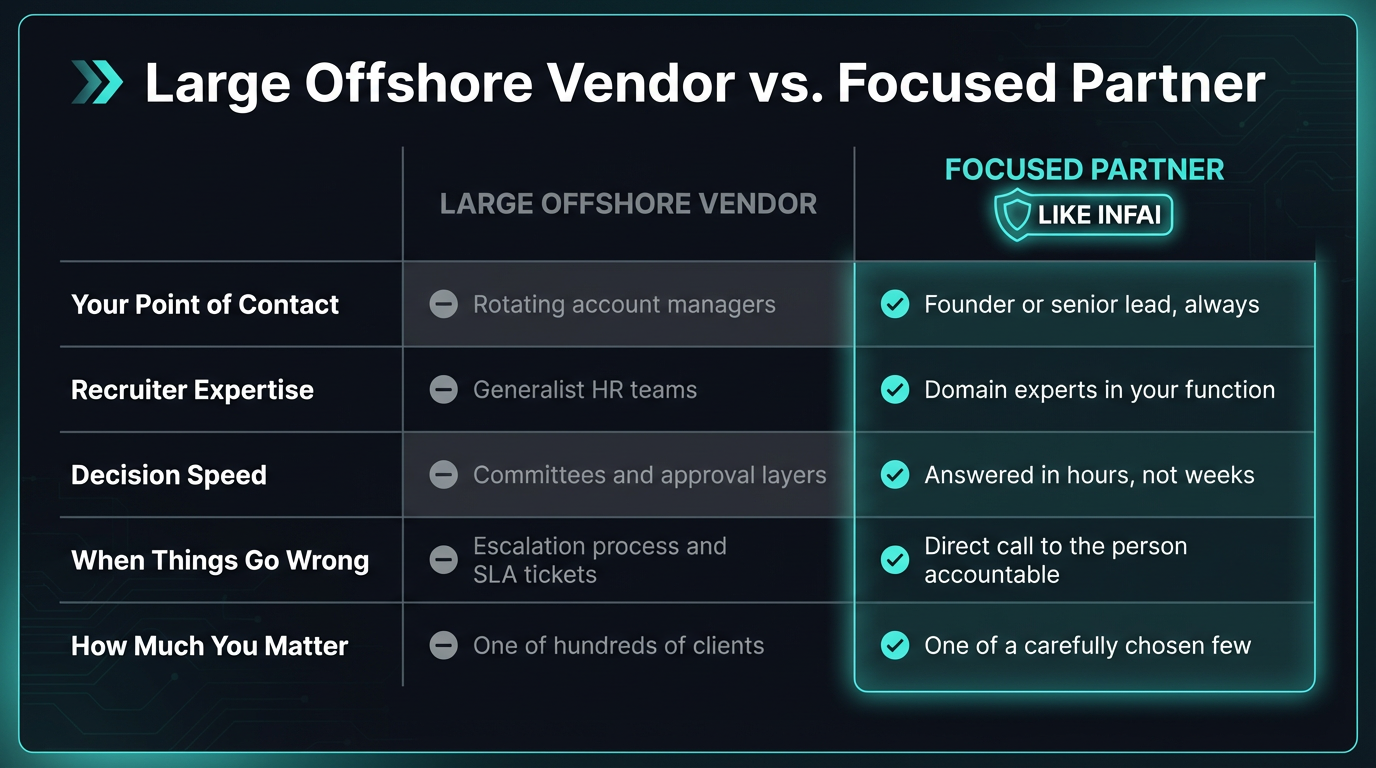
The 4 things a focused partner gives you that scale cannot
1. The person who made the promise is the person you call
At InfAI, when something needs resolving — a hire isn't working out, a process needs adjusting, a timeline needs renegotiating — you call the person who made the commitment to you. Not their delegate. Not an escalation ticket. The person who told you this would work.
That sounds like a small thing. It isn't. Accountability that lives in a person rather than a process produces completely different behaviour. Problems get solved faster. Difficult conversations happen sooner. The incentive to paper over issues rather than fix them disappears.
2. Recruiters who actually understand what they're hiring for
Our team has worked in the functions we hire for. When we're building a product design team, the person assessing candidates has done product design work and can evaluate whether someone's thinking is at the level your company needs. When we're sourcing analytics talent, we're asking questions that go beyond the CV.
This produces a different quality of shortlist. Not just candidates who match the job description — candidates who are genuinely right for the role, the team culture, and the specific kind of work you're doing.
3. Decisions that happen in hours, not weeks
Large vendor decisions go through layers. Pricing approvals. Legal review. Procurement processes. Account manager sign-off. This isn't bureaucracy for its own sake — it's the natural result of building a system that manages hundreds of clients simultaneously.
With a focused partner, the person you're talking to can make decisions. When a client asked us to accelerate a hire last quarter because their timeline shifted, we adjusted and had a revised shortlist within 48 hours. That kind of responsiveness isn't possible when decisions require committee sign-off.
4. Honest conversations, including the uncomfortable ones
A vendor with 200 clients and a quota to hit has a structural incentive to tell you what you want to hear. A focused partner whose reputation depends entirely on the success of a small number of relationships has a structural incentive to tell you the truth.
That means we'll tell you when we think your hiring brief is unrealistic. We'll tell you when the timeline you're proposing won't produce a good outcome. We'll tell you when we're not the right fit for what you need. These conversations are occasionally uncomfortable. They're also exactly what you need from someone who's supposed to be a genuine partner.
“The thing I appreciated most was that they pushed back on our initial brief. Every other vendor just said yes. InfAI told us why our requirements were creating problems and proposed a better approach. That's when I knew they actually understood what we were trying to do.
The honest trade-off
A focused partner isn't right for every company. If you need to scale from 0 to 150 people in 90 days, you need a firm with the infrastructure to support that — and we'd tell you that directly rather than overpromise and underdeliver.
The trade-off is straightforward: what you gain in accountability, expertise, and responsiveness, you trade for the raw scaling capacity and brand recognition of a larger firm. For companies where quality and fit matter more than speed and volume, that's a trade most of our clients happily make.
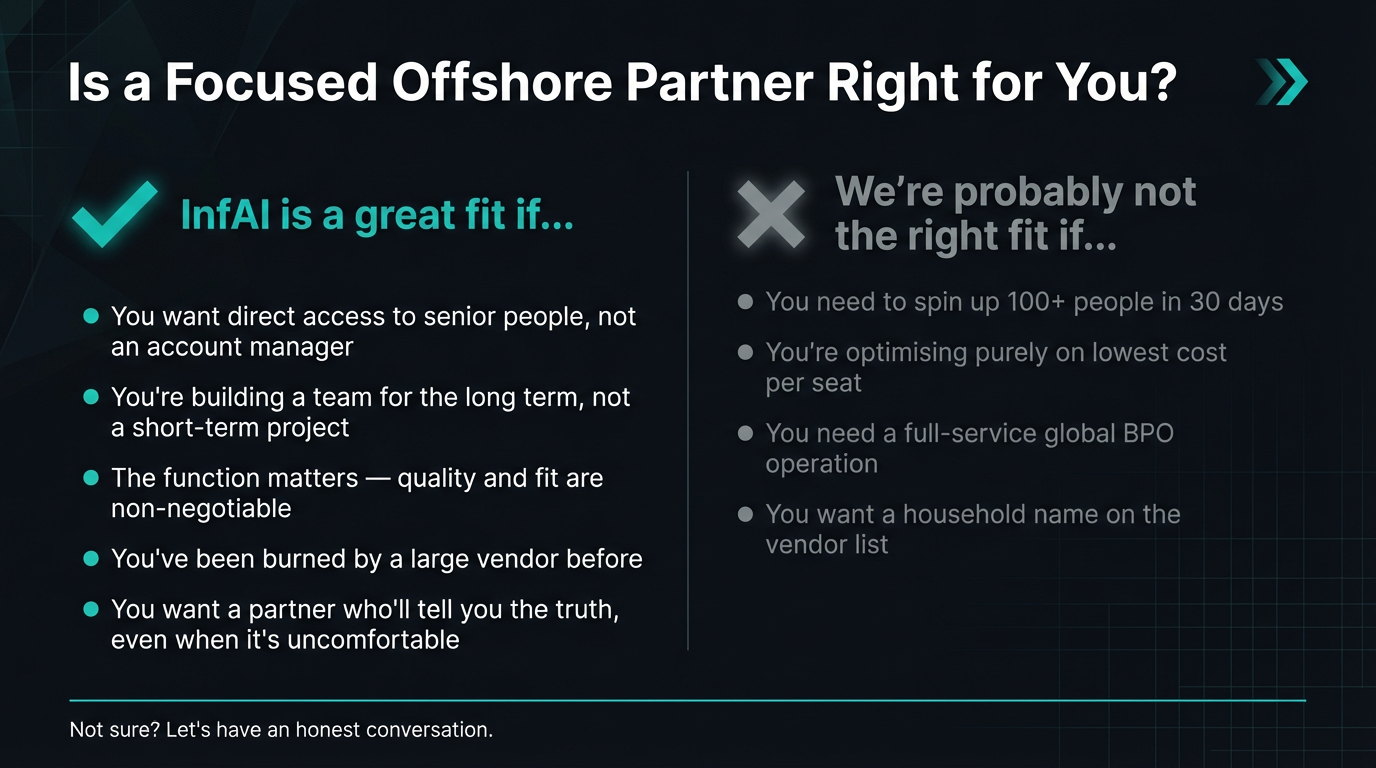
What this says about how offshore should work
The offshore industry has a trust problem. Too many companies have been sold on cost savings, watched quality disappoint, and concluded that offshoring doesn't work. Most of the time, it wasn't offshoring that failed them — it was a partner who wasn't genuinely invested in their outcome.
The model that actually works long-term is one where the partner's success is directly tied to the client's success. Where the same people who made the commitment are accountable for delivering it. Where the relationship is built on honest information, not optimistic pitches.
That's not a model that scales to hundreds of clients. But it's the model that produces teams that actually perform — and partnerships that last.
If you're evaluating offshore partners and something in this resonates, we'd genuinely enjoy the conversation. Not a sales call — a real discussion about what you're trying to build, whether India makes sense for it, and whether we're the right people to help.
FAQs
We deliberately keep our client base focused so every partner gets senior attention, not account manager coverage. We're selective about who we take on — not because of exclusivity, but because spreading too thin is how quality suffers. If our current capacity is full, we'll tell you upfront.
Software development, analytics and data, AI teams, product design, graphic design, brand design, and digital marketing. These are the functions our team has direct expertise in — we don't hire outside these areas because we wouldn't be able to assess quality the way we can in our core functions.
Most clients who come to us have. The most useful thing you can do is tell us specifically what went wrong — the hiring process, the integration, the communication, the quality bar. We can tell you honestly whether those are problems we're structured to solve, and show you specifically how our approach is different.
Directly and quickly. We don't have an escalation process — you call the person who's accountable. We'll assess the situation honestly, decide together whether a performance improvement plan makes sense or whether replacement is the right call, and act without the delays that come with larger vendor processes.
Both — but the fit depends more on how clearly defined the work is than on company size. An early-stage founder who knows exactly what they need and is ready to invest properly in integration is often a better client than a large company that hasn't thought through what offshore success looks like for them.
Mumbai's talent pool is different from other Indian cities in a specific way: the commercial ecosystem produces professionals with business judgment, not just technical execution skills. For functions like software development, analytics, design, and marketing — where understanding the "why" behind the work matters as much as the "what" — that mindset shows up in output quality.
Build Your Team, Not Just a Contract
With InfAI's offshore dedicated teams, you get professionals who join your workflow for the long run. Grow steadily, stay flexible, and work with people who care about your success as much as you do.